 Augusta University



 Toni Baker
MCG scientists now know how the immune system rids the body of tumor cells, helping prevent cancer metastasis.

A synthetic peptide disrupts the destructive inflammation that occurs in nephritis, enabling the kidneys to better recover and maintain function.

 Danielle Harris
South Carolina woman is can breathe easier thanks to a new procedure.

 Henry Hanks
Pioneers in the fields of big data analytics will speak at a workshop at the Georgia Cyber Center.

 Chris Curry
Researchers at the Georgia Cancer Center are taking the fight to rural Georgia communities with the extension of a program grant that provides smoking cessation and prevention services to African-American communities in partnership with area...

Augusta University Police will soon be equipped with a new tool to help children "bear" with trauma.

Our bodies are continuously concocting specific antibodies to thwart invaders like a virus or even pollen, and scientists have new information about how the essential production gets fired up and keeps up.

The nursing home will be recognized with Pinnacle's prestigious 2019 Customer Experience Award, a notable and timely honor for the staff of the award-winning facility that marks 50 years of service to veterans this year.

Scientists report that mice whose neurons don’t make estrogen have impaired spatial reference memory as well as recognition memory and contextual fear memory.

Dr. Xin-Yun Lu and her team have found inactive SIRT1 in the prefrontal cortex. Activating it may help turn classic symptoms of depression around, particularly in males.

The Association of American Physicians is an honorific, elected society of America’s leading physician-scientists who exemplify the pinnacle of pioneering and enduring, impactful contributions to improve health.

David L. Mattson, an established hypertension investigator and academic leader at the Medical College of Wisconsin, will join the MCG leadership team July 1.

When a car crash or explosion results in an optic nerve injury, eliminating an enzyme known to promote inflammation appears to aid recovery, scientists report.

A powerful immune molecule helps protect transplanted organs from rejection by putting a silencer on two other immune molecules that converge to take a direct shot at the organ, scientists report.

 Jennifer Hilliard Scott
Scientists at the Medical College of Georgia are looking at new treatment targets for the retinal damage that often accompanies diseases like diabetes, glaucoma and hypertension.

MCG's 23rd department is the Department of Dermatology, and Dr. Loretta S. Davis has been named its chair.

 Christen Engel
South Carolina residents can begin receiving in-state tuition this fall for most undergraduate and select graduate programs at Augusta University.

Scientists are working to analyze the genes of hundreds of patients born with a missing or underdeveloped vagina and uterus to get a better idea about causes, improve genetic counseling and improve treatment.

A conference to train health care providers from across rural Georgia in the latest and best practices in emergency medicine will be held Feb. 9-10 at the Medical College of Georgia at Augusta University.
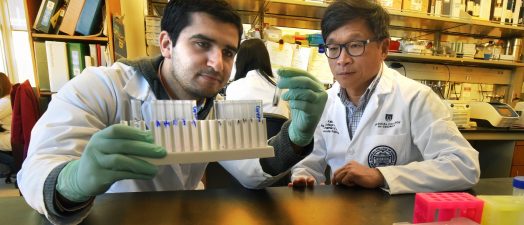
Lingering inflammation in the colon is a known risk factor for colorectal cancer, and now scientists report one way it resets the stage to enable this common and often deadly cancer.