Augusta University

 Milledge Austin
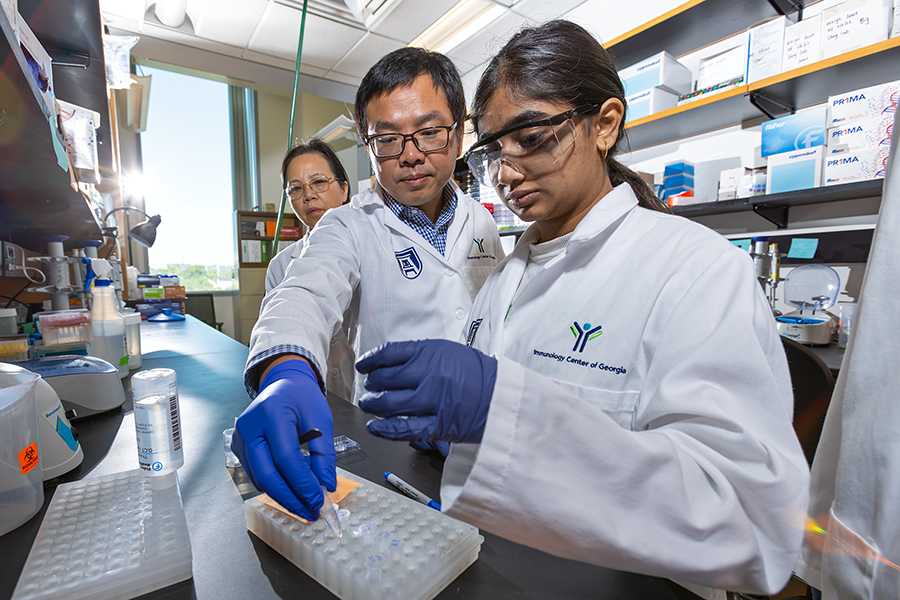
A researcher with the Immunology Center of Georgia, part of the Medical College of Georgia at Augusta University, has received a five-year, $3.8 million grant from the National Institutes of Health to study how a molecule in blood vessels may help protect against atherosclerosis, a cardiovascular disease that can lead to heart attacks and strokes.
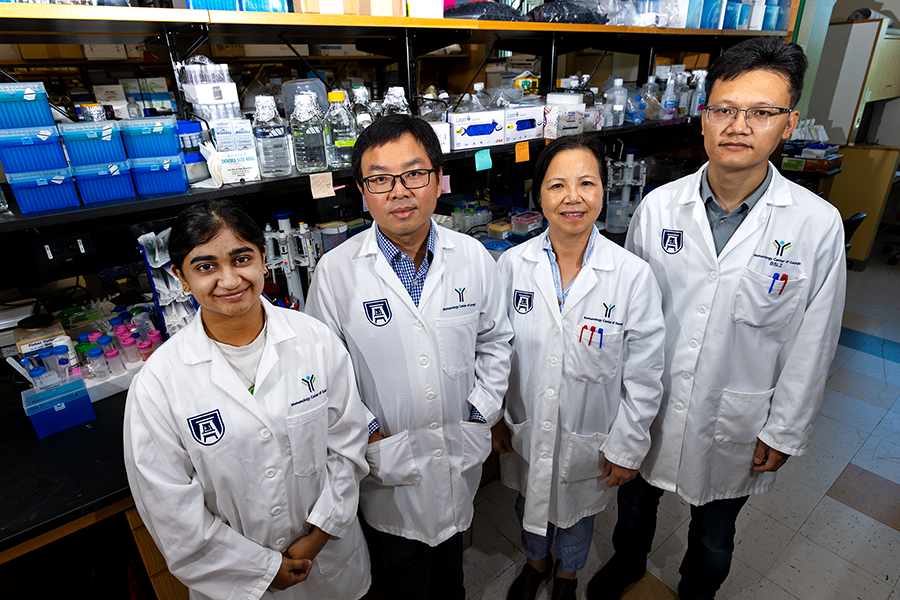
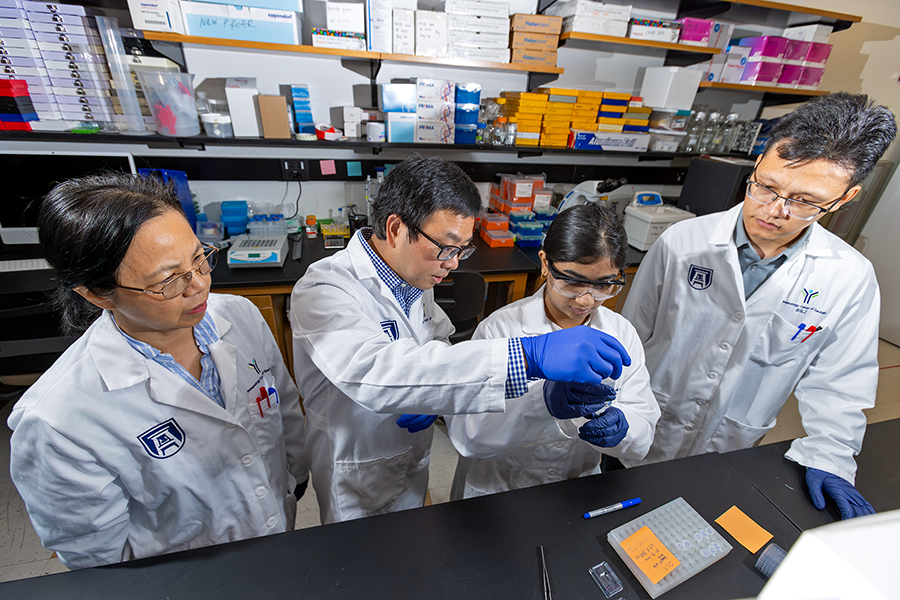
Kunzhe Dong, PhD, an assistant professor with IMMCG and MCG’s Department of Pharmacology and Toxicology, received the NIH R01 grant for his project, “Role of vascular smooth muscle cell-enriched lncRNA in atherosclerosis.”
Dong’s research focuses on PRDM16-DT, a long noncoding RNA (lncRNA) molecule. Unlike RNA molecules that carry instructions for making proteins, lncRNAs help control how cells use their genes.
“With this grant, we will determine how PRDM16-DT – which is highly enriched in healthy blood vessels and smooth muscle cells, and contains genetic variants associated with atherosclerosis – regulates muscle cell function in disease and underlying molecular mechanism, and how these genetic variants controls the expression of this long noncoding RNA,” Dong said. “It’s our hope that we will identify a novel therapeutic target that can be used for treatment and prevention of atherosclerosis.”
PRDM16-DT is found at high levels in the smooth muscle cells that help blood vessels maintain their structure and function. Dong wants to understand how PRDM16-DT affects these cells and whether it helps protect blood vessels from disease.
“Long non-coding RNAs are understudied,” said Klaus Ley, MD, founding co-director of the Immunology Center of Georgia, Georgia Research Alliance Bradley Turner Eminent Scholar Chair in Immunology and professor of physiology. “Studying PRDM16-DT holds promise for understanding its role in smooth muscle cells in the walls of arteries. Smooth muscle cells are important in atherosclerosis, the process causing most heart attacks.”
Atherosclerosis develops when cholesterol and other substances build up inside artery walls, forming deposits called plaques. As these plaques grow, they can narrow the arteries and restrict blood flow. Plaques can rupture and trigger blood clots, which may cause heart attacks and strokes.
Smooth muscle cells help keep blood vessels healthy, but they can change as atherosclerosis develops, contributing to plaque formation and disease progression. Dong and his team are investigating whether PRDM16-DT helps these cells maintain their normal function and what happens when levels of the molecule decrease.
“We will address three major questions. First, we will determine how this long encoding RNA regulates smooth muscle cell function during atherosclerosis. Second, we will study the underlying molecular mechanisms. Third, we will investigate how these genetic variants control this lncRNA suppression in smooth muscle cells,” Dong said.
The research builds on Dong’s earlier work, which includes a $77,000 American Heart Association Bridge Career Development Award he received earlier this year. The AHA award supports a component of the broader research now being advanced through the NIH grant.
In that work, Dong and his team analyzed existing genetic data from people with and without atherosclerosis. They found genetic variations linked to both a higher risk of the disease and lower levels of PRDM16-DT.
Some of these variations occur in parts of DNA that help control when genes are active and how much of a molecule a cell produces. The findings suggest that certain genetic variations may lower PRDM16-DT levels in smooth muscle cells, potentially contributing to atherosclerosis.
The team also tested the molecule’s role in mouse models. When they removed the mouse equivalent of PRDM16-DT, the animals developed more severe atherosclerosis and had more inflammation in their arterial plaques. The team also found changes in smooth muscle cells consistent with disease progression.
“It’s our hope that we will identify a novel therapeutic target that can be used for treatment and prevention of atherosclerosis.”
Kunzhe Dong, PhD
In laboratory experiments, reducing PRDM16-DT levels caused smooth muscle cells to lose some of their normal characteristics. Increasing its levels had the opposite effect. These early findings suggest that PRDM16-DT may help protect blood vessels by keeping smooth muscle cells functioning properly.
Dong’s research builds on years of studying how PRDM16 and related genetic variations affect blood vessel health. Earlier this year, his research was published in the Journal of Molecular and Cellular Cardiology in a study titled, “Coronary artery disease risk gene PRDM16 regulates smooth muscle homeostasis.”
The study examined how PRDM16-related genetic activity affects vascular smooth muscle cells and their role in maintaining healthy blood vessels. This work adds to the foundation for Dong’s continued investigation into how genetic differences influence these cells and contribute to cardiovascular disease.
His current NIH-funded project focuses specifically on PRDM16-DT, a related but distinct molecule. By investigating how it works and how genetic variations affect its activity, Dong hopes to better understand the development of atherosclerosis and identify potential targets for future treatments.
“Our preliminary shows this lncRNA is reduced in atherosclerosis, and also genetic evidence shows so increased risk of disease associated with lower expression of this gene,” Dong said. “So, we expect to see removing this gene from smooth muscle cells will increase disease development, and increase expression in smooth muscle cells will rescue the disease or make the disease better.”
Although more research is needed before these findings could lead to a treatment, Dong’s work could help scientists better understand how genetic differences contribute to cardiovascular disease and identify new ways to prevent or slow atherosclerosis.


 Staff
 Hannah Litteer

 Chris Curry