Augusta University
 Milledge Austin
A gene previously best known in brown fat tissue has been found to be active in blood vessel walls, especially in the muscle cells that help arteries contract and maintain their structure according to findings recently published in the Journal of Molecular and Cellular Cardiology.
In the study, “Coronary artery disease risk gene PRDM16 regulates smooth muscle homeostasis,” Kunzhe Dong, PhD, an assistant professor and researcher with the Immunology Center of Georgia, part of the Medical College of Georgia at Augusta University, looked at the role PRDM16 plays in regulating smooth muscle homeostasis. The study builds off work Dong performed as a postdoctoral fellow in the lab of Jiliang Zhou, PhD, a former professor in MCG’s Department of Pharmacology and Toxicology.
“I have been working on this for many years, starting as a postdoc where we combined different genomic sequencing data like genome-wide association studies and single cell sequencing,” said Dong, who recently received a Bridge Career Development Award from the American Heart Association for another project investigating a long non-coding RNA located next to PRDM16. “At that time we were data mining to combine different genomic sequencing data, and that’s when we identified a transcription factor called PRDM16. This gene is historically known to be a very important gene in the brown fat tissue.”
Dong and his team found that PRDM16 is highly expressed in arterial tissues and vascular smooth muscle cells, also known as VSMCs and deleting PRDM16 significantly alters the expression of genes associated with VSMC phenotypic modulation and vascular disease progression.
Vascular smooth muscle cells are the main structural cells in blood vessels. Under healthy conditions, they help vessels contract and maintain stability, but during diseases such as coronary artery disease or after procedures like stenting, these cells can switch into a different state where they multiply, migrate and contribute to vessel narrowing.
Dong’s team set out to better understand what controls this switch. They focused on super-enhancers, regions of DNA that strongly regulate genes responsible for maintaining a cell’s identity. By analyzing enhancer activity across human artery samples, they were surprised to find PRDM16.
Further analyses confirmed that PRDM16 is highly expressed in arterial tissues, particularly in healthy, contractile smooth muscle cells, but becomes reduced when those cells shift into their disease-associated state.
“PRDM16 is very active and highly expressed in vascular smooth muscle cells. That was unexpected, because most of the literature focused on brown fat, not vascular disease,” Dong said. “Some mutations in this gene have been associated with coronary artery disease or atherosclerosis, but its function there was unknown. We thought this was a big discovery because it connected a well-known gene to a completely different system.”
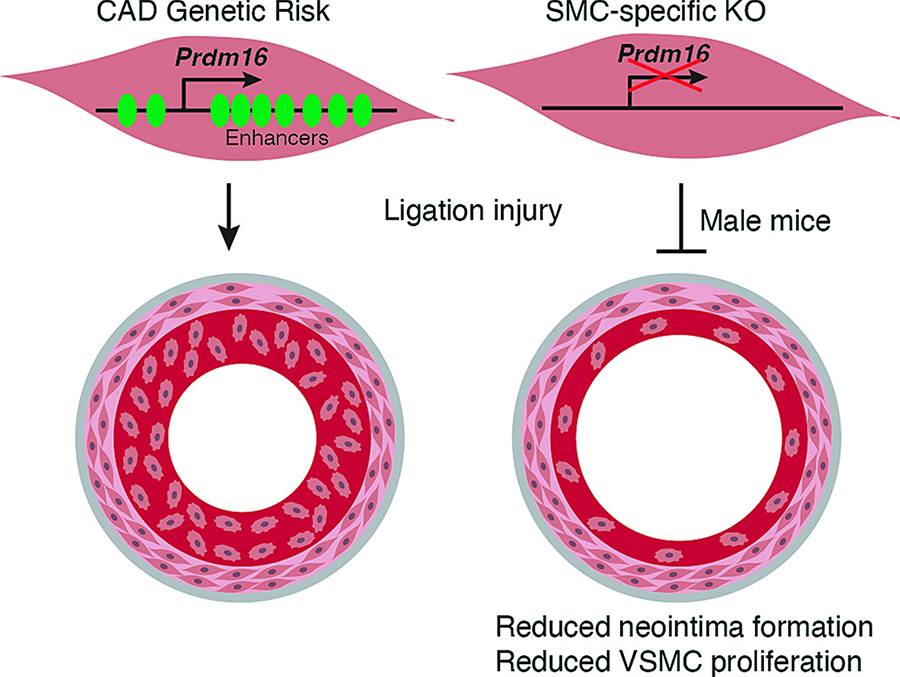
To test what the gene actually does, the team created mouse models where PRDM16 was removed from vascular smooth muscle cells. Under normal conditions, the loss of PRDM16 did not appear to affect blood vessel structure, but when the vessels were injured to mimick what happens during vascular procedures, the researchers noticed a significant difference.
Without PRDM16, smooth muscle cells were less likely to multiply and form the thickened inner layer, known as neointima, that can narrow arteries. In male mice, absence of PRDM16 in smooth muscle cells resulted in significantly reduced neointima formation, suggesting the gene plays an active role in controlling vessel remodeling.
The team also found that PRDM16 regulates levels of another signaling molecule, TGFB2, which is part of a pathway known to influence smooth muscle cell behavior. Under normal conditions, PRDM16 suppresses TGFB2 activity by limiting its gene expression. When PRDM16 is absent, this regulatory balance shifts, altering how smooth muscle cells respond to injury.
Together, the findings suggest that PRDM16 acts as an important regulator of smooth muscle cell behavior and blood vessel health. Although the gene had been widely studied in a completely different biological context, this work shows it also plays a key role in the cardiovascular system making it a potential future target for therapies aimed at preventing artery narrowing and related diseases such as coronary artery disease or restenosis.
“This gene is well known in one field, but now we’re seeing it’s also important in cardiovascular cells. That’s what makes it interesting. It connects different biological systems,” Dong said. “One direction for future research is to study how genetic variants regulate this gene and how they affect its expression or function. Another direction is to test it in different vascular disease models.”


 Paige Tucker
 Valerie Emerick
 Stacey Hudson