 Augusta University

 Morgan Hayes
A new study from Augusta University researchers examined how contact with the criminal legal system may affect the mental health of adolescents and young adults, with some effects continuing up to a year after an initial encounter.
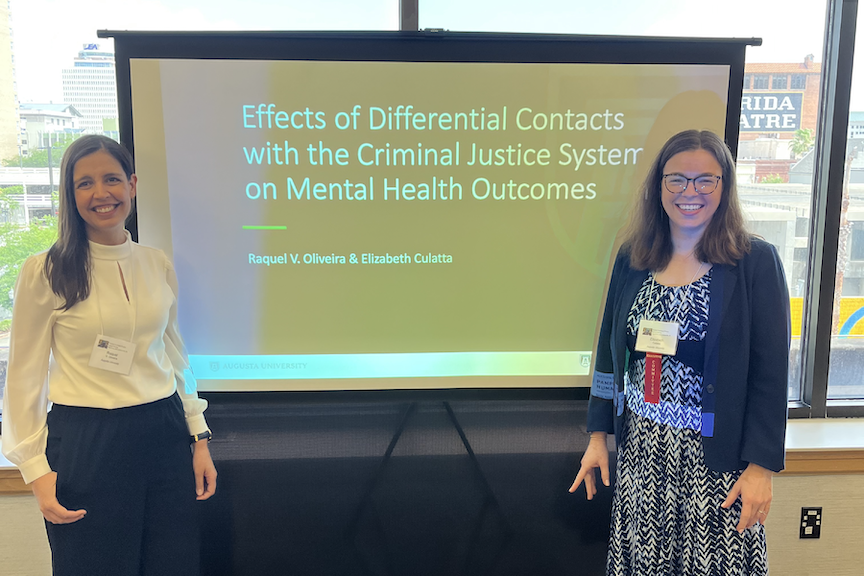
Raquel V. Oliveira, PhD, associate professor of criminal justice, and Elizabeth Culatta, PhD, associate professor in sociology in the Katherine Reese Pamplin College of Arts, Humanities, and Social Sciences and associate director of the Center for Social Science Research, recently published their study, “Effects of differential contacts with the criminal legal system on mental health outcomes of adolescents and young adults: A fixed-effects model,” in PLOS One.
The study expands on previous research by looking beyond incarceration alone. Oliveira and Culatta examined how different types of legal system contact, including arrests, court appearances and institutionalization, were associated with symptoms of anxiety, depression, hostility and psychoticism over time.
Using data from the Pathways to Desistance study, the researchers followed 1,354 young people who had received an adjudication from a judge in Phoenix or Philadelphia. Participants were between 14 and 18 years old when first interviewed and were followed for seven years, offering a look at how these experiences may affect mental health during the transition into adulthood.
“This paper by two of our outstanding colleagues demonstrates how collaborative research in the Social Sciences can produce meaningful findings with real-world impact,” said William Hatcher, PhD, chair of the Department of Social Sciences.
The researchers found that different types of legal system contact were associated with different outcomes. Arrests and institutionalization were linked to short-term increases in several mental health symptoms, while court appearances were associated with longer-term increases in anxiety, depression and psychoticism.
For Oliveira and Culatta, studying this age group is especially important because adolescence and young adulthood are already periods of major change involving education, careers, relationships and other life transitions.
Their research also adds another layer to conversations surrounding mental health and the criminal legal system. While mental health diagnoses are overrepresented among adolescents and young adults within the system, the researchers caution against assuming that mental health concerns lead to criminal behavior. Instead, their findings suggest that contact with the legal system itself has detrimental effects on mental health outcomes.
“By demonstrating how interactions with the legal system can directly impact the mental well-being of young people during vital transitional years, their work provides crucial evidence for policymakers and community leaders seeking meaningful, supportive interventions. We are incredibly proud of the impactful scholarship being led here at Pamplin College,” said Kim Davies, PhD, professor of sociology in Pamplin College.
The researchers hope the findings encourage continued investment in diversion programs and mental health support for young people who encounter the criminal legal system.
Moving forward, Oliveira and Culatta hope to further examine the reciprocal effects between a range of mental health symptoms and legal system involvement and whether they share common risk factors.


 Jennifer Hilliard Scott

 Chris Curry

 Felicia Baskett

 Valerie Emerick