Augusta University
 Milledge Austin
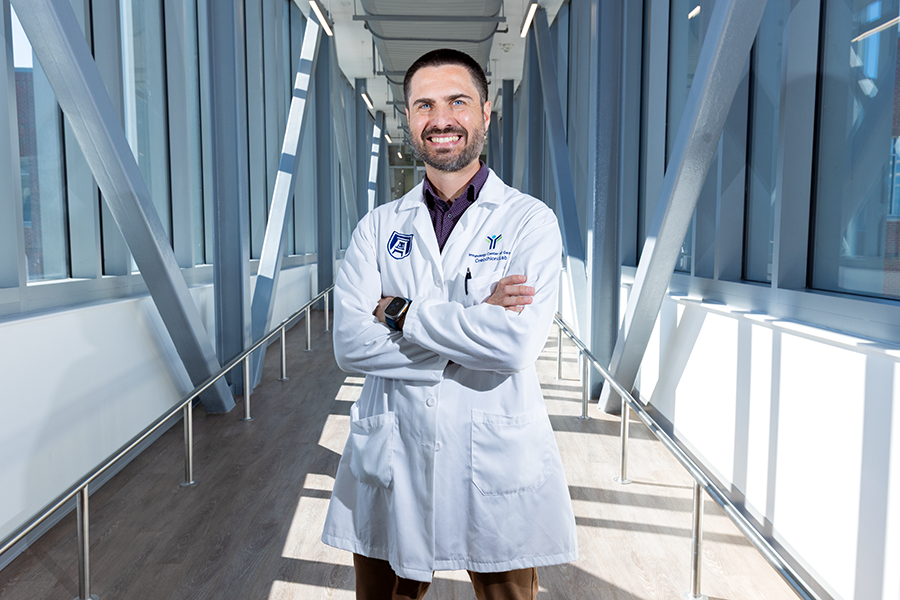
Marco Orecchioni, PhD, a researcher with Immunology Center of Georgia, part of the Medical College of Georgia at Augusta University, has been awarded the prestigious NIH Director’s New Innovator Award by the National Cancer Institute, part of the National Institutes of Health.
The grant, which is classified as high-risk, high-reward, is for nearly $3.66 million over the next five years, and will fund Orecchioni’s project, “Harnessing Myeloid Olfactory Receptors to Reprogram Tumor Immunity.”
“Some years ago, we discovered that olfactory receptors are expressed in immune cells such as macrophages and monocytes. This award will allow us to explore whether these receptors can influence how these immune cells respond to tumors and drive either anti-tumor or pro-tumor responses,” said Orecchioni, who is also an assistant professor in MCG’s Department of Pharmacology and Toxicology.
NIH Director’s Awards, or DP2 awards, are prestigious awards given to scientists proposing exceptionally creative, high-impact research at all career stages. The awards were established to support unconventional approaches to major challenges in biomedical and behavioral research. Funding for the awards comes from the NIH Common Fund, the National Institute of Environmental Health Sciences (NIEHS) and the National Institute on Deafness and Other Communication Disorders (NIDCD).
The NIH Common Fund supports a series of exceptionally high-impact programs that cross NIH institutes and centers. Common Fund programs pursue major opportunities and gaps in biomedical research that require NIH-wide collaboration to succeed. The High-Risk, High-Reward Research Program, part of the NIH Common Fund, manages the following four awards: the Pioneer Award, the New Innovator Award, the Transformative Research Award and the Early Independence Award. In particular, the New Innovator Award, established in 2007, supports unusually innovative research from early career investigators who are within 10 years of their final degree or clinical residency and have not yet received a large independent NIH grant.
“This is an amazing achievement because very few scientists receive a DP2 award,” said Klaus Ley, MD, founding co-director of the Immunology Center of Georgia, Georgia Research Alliance Bradley Turner Eminent Scholar Chair in Immunology and professor of physiology. “IMMCG is proud to have Marco among our great young faculty.”
Researchers have traditionally associated olfactory receptors with the sense of smell, but Orecchioni previously discovered that these receptors can also be found on immune cells known as macrophages and monocytes. His research showed that these receptors can detect oxidation-derived chemicals and other signals in the body, influencing inflammation and disease progression. The discovery opened a new avenue of research into how these “immune noses” regulate immune function and whether they can be targeted to treat disease.
With support from the NIH Director’s New Innovator Award, Orecchioni will investigate how these receptors affect macrophage behavior within melanoma tumors. The project aims to determine whether specific olfactory receptors can drive these immune cells toward tumor-fighting or tumor-supporting functions and whether they play a role in how patients respond to immunotherapies, such as immune checkpoint inhibitor therapy. Using advanced technologies, including spatial transcriptomics and single-cell analysis, the research could identify new targets for future cancer treatments.
“We have preliminary data suggesting that one olfactory receptor may help drive beneficial immune responses against melanoma,” Orecchioni said. “The goal now is to understand how these receptors influence disease progression and whether they affect a patient’s response to immunotherapy.”
Since arriving at Augusta University in 2023 from the La Jolla Institute for Immunology in California, Orecchioni has quickly earned national recognition for his research accomplishments. He was recently selected for the Circulation Research Early Career Editorial Board, received a 2026 American Association of Immunologists Early Career Faculty Travel Grant and was featured on The Immunology Podcast. Earlier this year, he was also one of four Augusta University researchers to receive an American Heart Association Bridge Career Development Award.
Most recently, Orecchioni traveled to Alghero, Sardinia, his home island in Italy, where he presented his laboratory’s research at CONFAMI 2026 and participated in the launch of the Horizon Europe OMNIA MSCA Staff Exchanges project.


 Staff
Staff
 Hannah Litteer
 Chris Curry