 Augusta University

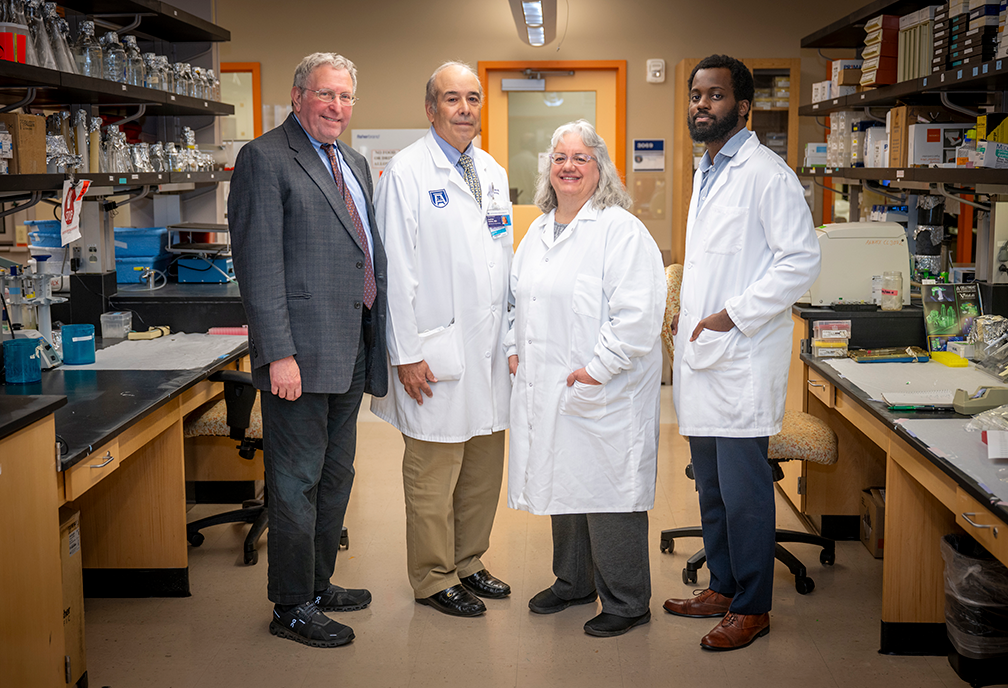
 Jennifer Hilliard Scott
A second cycle of a National Institutes of Health training grant at the Medical College of Georgia at Augusta University is expanding opportunities for medical students to gain hands-on experience in aging research, including a new program designed specifically for MCG students.
Wendy Bollag, PhD, a professor in the MCG Department of Physiology, and Carlos Isales, MD, J. Harold Harrison Distinguished University Chair in Healthy Aging and chief of the Division of Endocrinology Diabetes & Metabolism, are principal investigators on the T35 training grant, which will support approximately 14 to 15 medical students each year in eight- to 12-week research experiences with MCG investigators.
The grant builds on the Program for Aging Research in the Summer, or PARIS, which Bollag and Isales established through a previous T35 grant to introduce medical students to aging research and clinical care. The program brought students from medical schools in the Southeast and Puerto Rico to MCG for an immersive summer research experience.
But changes to MCG’s medical school curriculum – moving from a four-year curriculum to three – created a challenge: MCG students no longer had the traditional summer break between their first and second years that made participating in PARIS possible.
The new grant addresses that by adding the Program for Aging Research in Training Years 2-4, or PARTY, which allows MCG students to complete their research experience during the later years of medical school.
“When we had the first iteration of the T35, MCG was moving to the 3+ curriculum, and our students essentially lost that traditional summer off when they could participate in PARIS,” Bollag said. “When we decided to apply for the T35 again, we wanted to make sure we created an opportunity for our own MCG students to participate as well.”
The expansion comes as MCG’s aging research enterprise has grown significantly, giving students more opportunities to learn from investigators studying the biological processes that contribute to age-related disease.
“The number of aging researchers here has increased substantially, and that gives students more researchers to choose from and more opportunities to work in their labs,” said Isales, clinical director of the MCG Center for Healthy Aging. “It also helps us build a pipeline of future researchers who are interested in aging.”
That pipeline is increasingly important as the U.S. population grows older and researchers look for new ways to help people remain healthier longer.
“We need to develop new strategies and treatments that increase health span so people remain healthier as they age, and for those who do develop health problems, we need better treatments,” Isales said. “Getting young researchers involved and focused on aging research is an important part of that.”
MCG student is first PARTY participant
Senior MCG student Peter-Jon Williams is the first student to participate in PARTY.
Williams spent eight weeks working with Brian Annex, MD, chair of the MCG Department of Medicine, whose research focuses in part on peripheral artery disease, angiogenesis and vascular remodeling.
Williams met Annex during a cardiology rotation and was drawn to his work as both a physician and researcher.
“I thought he was a great physician, and when I found out he was a researcher as well, I thought he would be a great person for me to have as a research mentor,” Williams said.
Under Annex’s mentorship, Williams is studying peripheral artery disease, or PAD, an age-associated vascular disease in which narrowed or blocked arteries reduce blood flow to the limbs, particularly the legs. Annex has spent decades studying PAD and potential approaches to improving treatment for patients with vascular disease.
For Williams, the experience provides a chance to connect what happens in the clinic with what happens at the laboratory bench. He works with patients in the vascular clinic, collects samples and then brings those samples back to the lab to investigate the biology of the disease.
That bench-to-bedside connection is central to his interest in becoming a physician who remains engaged with research throughout his career.
“As medicine evolves, physicians can’t be completely isolated from the evolving science,” Williams said. “Even if it’s not through a formal MD/PhD path, being invested in the science as it develops is something I think will benefit me as a physician.”
PARTY expands the research opportunities available to MCG students by offering a dedicated experience focused on aging research.
“It’s a great opportunity for medical students to have a block of time where they can really dedicate themselves to something like this,” Williams said. “Having these eight weeks to really immerse myself in it has been great.”
Bollag and Isales hope that kind of intensive experience will encourage more medical students to consider research as part of their careers.
“Physician-scientists are an important part of the research enterprise,” Isales said. “Giving students the opportunity to become involved in research while they are still in medical school will hopefully translate into them continuing those efforts later on.”
The grant also aims to strengthen the mentoring students receive. Bollag and Isales are partnering with resources across Augusta University, including The Graduate School, to develop training opportunities for faculty mentors working with medical students.
PARTY participants also receive education in the biology of aging similar to that offered through PARIS. Because they are participating at different points throughout the academic year, MCG students can access recorded coursework developed by Augusta University’s aging research community to supplement their laboratory experiences.
The goal, Bollag said, is to provide both PARIS and PARTY participants with a deeper understanding of aging research while surrounding them with experienced mentors who can show them what a career combining medicine and discovery can look like.
For Isales, that investment in students is especially important given the growth of aging research at MCG and the need for researchers who will carry the work forward.
“We have an opportunity to expose students to aging research at a time when they’re still deciding what their careers are going to look like,” he said. “Hopefully, some of them will decide this is something they want to continue doing.”

 Jamison Guice

 Jaylon Brooks
 Milledge Austin
 Stacey Eidson