 Augusta University

 Erin Weeks
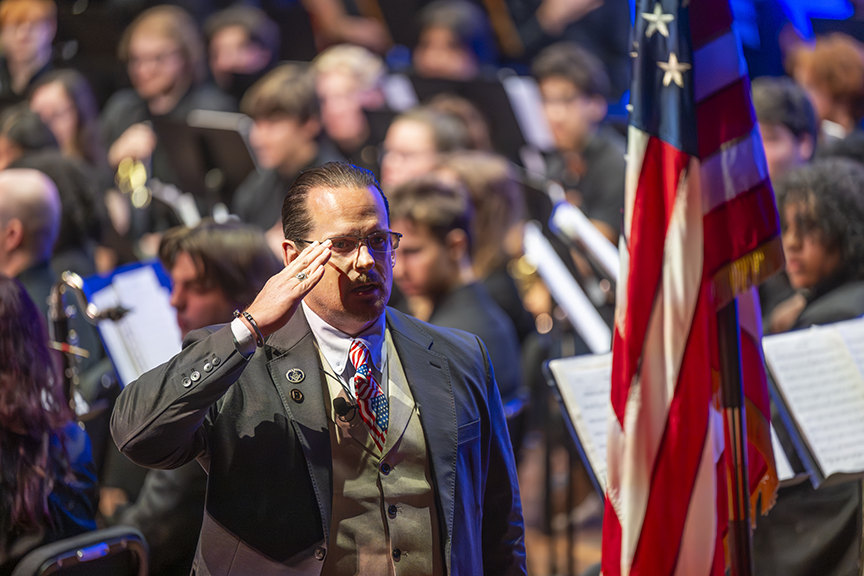
Augusta University’s Military and Veteran Services has been honoring the Central Savannah River Area’s military community for more than a decade with its annual Veteran’s Day recognition event, a tradition that dates back to 2014.
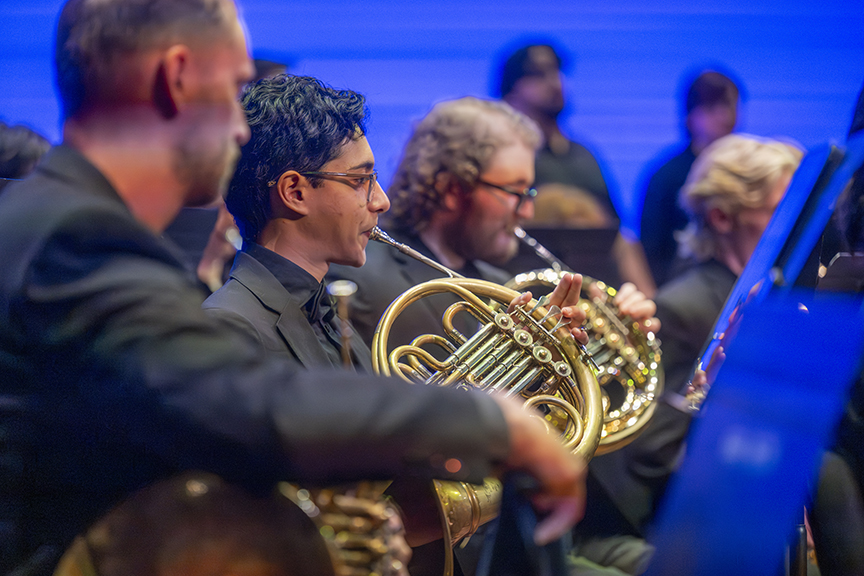
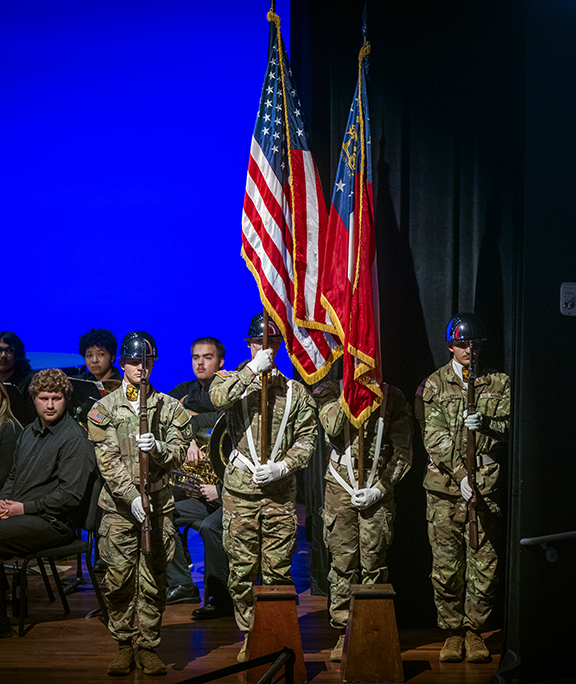
The event returned to the Grover C. Maxwell Performing Arts Theatre on Nov. 11, where a veteran pin ceremony, an armed forces salute and a presentation of the colors by the university’s Army ROTC squad were punctuated by patriotic sounds from the Augusta University Wind Ensemble.
In the audience, student veteran Shelita Johnson, a Cybersecurity major in the School of Computer and Cyber Sciences and a former U.S. Navy Police for nearly two decades, took in the atmosphere.
“What stood out to me most was seeing the university community come together to recognize and honor those who have served our country,” she said. “I also enjoyed the music and that various professors took part in it. It was beautiful how outside vendors that support veterans were there in support of the event and to see different generations and branches of veterans being recognized.”
“Events like these are important because they remind veterans that their service and sacrifices are not forgotten,” she added. “Transitioning to college made me feel like I was leaving behind a community that has been a major part of who I am. These events help build a sense of connection and conversation between civilians and veterans.”
Johnson is one of a growing number of Augusta students who has a military connection; Military and Veteran Services shares that as of fall 2026, the institution serves around 1,898 military-affiliated students, a figure that represents veterans, active-duty service members, reservists, National Guard members and eligible military dependents.
“During my military career, I developed a strong foundation in security, operations, leadership, and protecting valuable assets,” she said. “My education at Augusta University is helping me expand those skills into the technological world. Beyond my professional goals, I also want to be an example for my children and other veterans who may be considering returning to school. I want them to understand that it is never too late to pursue a new dream, change career paths, or challenge yourself to accomplish something greater. Augusta University is helping me write a new chapter of my life.”
“I believe student veterans bring a unique combination of real-world experience, leadership, discipline, adaptability, and technical knowledge into the workforce. Many veterans have already worked in high-pressure environments where teamwork, accountability, communication and decision-making were essential to completing a mission,” she added.
Retired Col. Eric Toler, Executive Director of the university’s Georgia Cyber Center, said that the number of veteran students on campus increases substantially each year, a continuous growth that correlates with the transition of the U.S. Army Cyber Command headquarters from Fort Belvoir, Virginia, to nearby Fort Gordon in 2020 – a move that also served as a catalyst for the creation of the Cyber Center.
“During my military career, I developed a strong foundation in security, operations, leadership, and protecting valuable assets. My education at Augusta University is helping me expand those skills into the technological world.”
Shelita Johnson, an Augusta University Cybersecurity major and former U.S. Navy Police
Toler equally attributes the rise of this particular student population to the addition of relevant degree programs over recent years, including a Bachelor of Science in Cybersecurity, a Master’s in Cybersecurity Management and Technology and the Intelligence, Defense, & Cybersecurity Policy PhD program.
“Those degrees are what’s bringing these students to AU, in addition to your more traditional subjects. Those were specifically developed because of the demand that the military was putting on AU, and we’ve delivered,” said Toler. “We’ve had more and more students from the military and other government entities that choose to be Jaguars.”
With Fort Gordon being an economic pillar in the community and the university being labeled a Military Friendly institution, the value in connecting with veterans on campus has become increasingly clear.
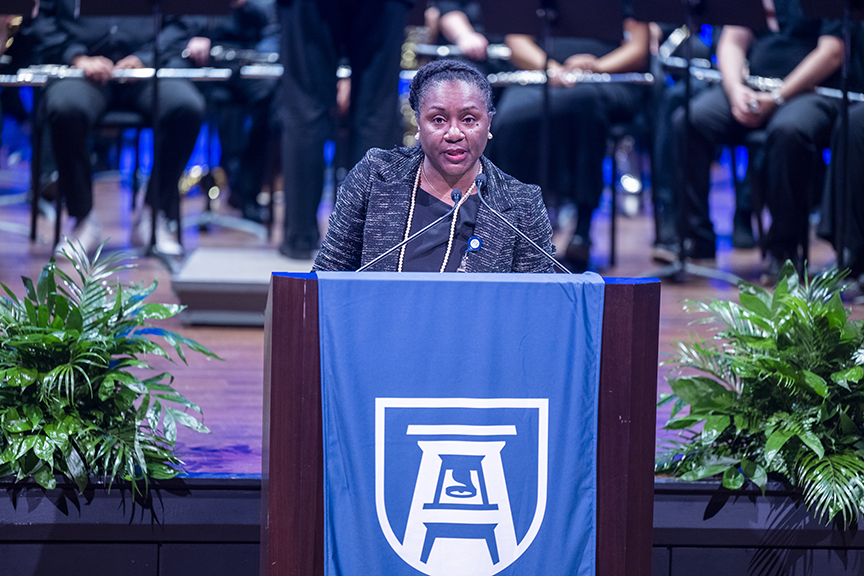
“As we continue to grow and focus on our strategic enrollment goals, we’re focusing more on our military and adult learner population,” said Lakishia Dinkins, interim director of Military and Veteran Services & Fort Gordon Site Coordinator.
So, what does it mean to be a military-friendly campus?
One student veteran said it means being surrounded by others that also have military connections.
“I think a large part of what makes Augusta University a good environment for veterans is the proximity that many faculty and students have to the military in some form or another. The amount of folks I’ve spoken to on campus who either have a family member, friend, etc. that was or is in the military is pretty incredible,” said student veteran Omar G., a business administration major in the James M. Hull College of Business who was enlisted in the U.S. Air Force for several years.
“Most people here ‘get it,’ so to speak. They understand that we’re all here for the same thing even if we arrived here through different paths,” he said. “Since attending I’ve never felt different than any other student, whether in talking with professors or classmates.”
Johnson said that for her, it means having support embedded into the college experience through resources meant just for veterans.
“The amount of folks I’ve spoken to on campus who either have a family member, friend, etc. that was or is in the military is pretty incredible.”
Omar G., an Augusta University business administration major and U.S. Air Force veteran
“Having a welcoming environment is very important. Through my involvement with Augusta University’s Military and Veteran Services office, I have had the opportunity to connect with fellow veterans, active-duty service members, and military-connected students,” she said. “I understand how overwhelming it can feel to navigate educational benefits, academic expectations, and personal responsibilities after military service. I see the impact these resources have on other students. It is encouraging to know that Augusta University recognizes the sacrifices made by military families and continues to provide support as we work toward our educational and professional goals.”
“I think one thing the average student may not realize is that student veterans are often navigating more than class assignments,” she shared. “Many of us are balancing families, careers, adjusting to physical limitations, financial responsibilities, rebuilding their confidence, or learning how to identify themselves outside of their military careers. We are working on becoming new versions of ourselves after serving our country. My goal is to use my cybersecurity education to transition into a meaningful career where I can continue serving and protecting others.”

 Aaron Smith
 Jaylon Brooks
 Staff