Augusta University

 Stacey Eidson
Hearing a doctor say the word “cancer” is devastating news for most patients.
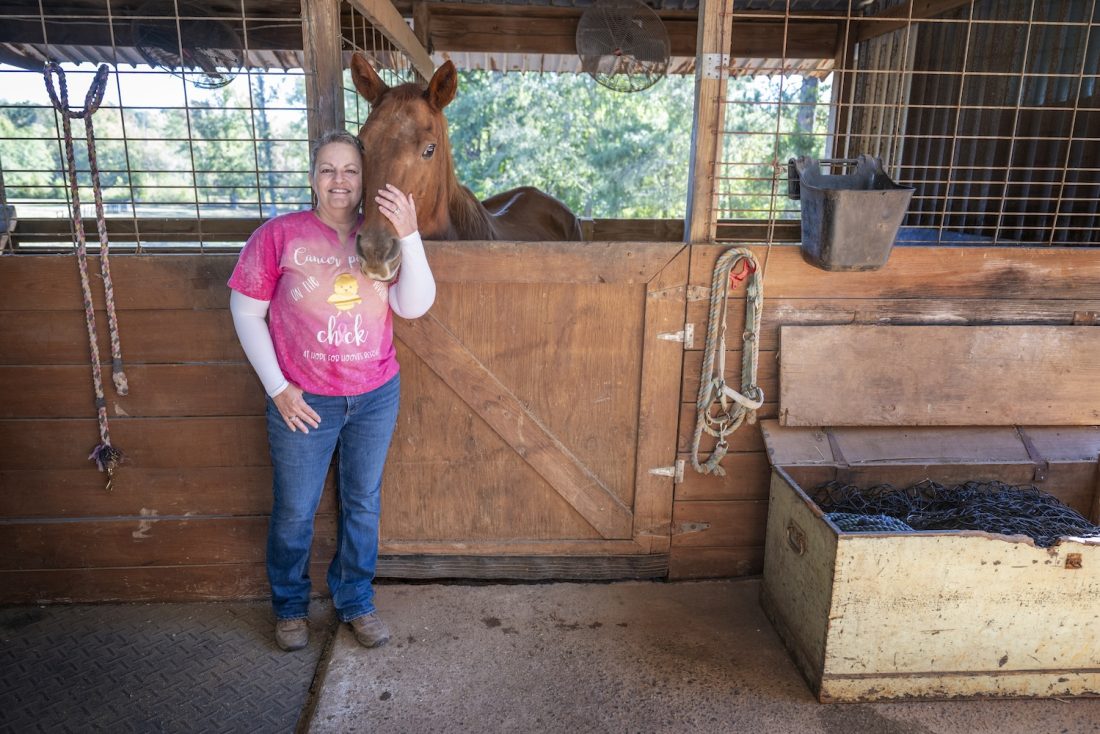
For Michelle Derrick of North Augusta, she no longer fears the disease.
She has faced breast cancer four times since 2013. At one point, doctors told Derrick she could have less than three months to live. But Derrick didn’t back down.
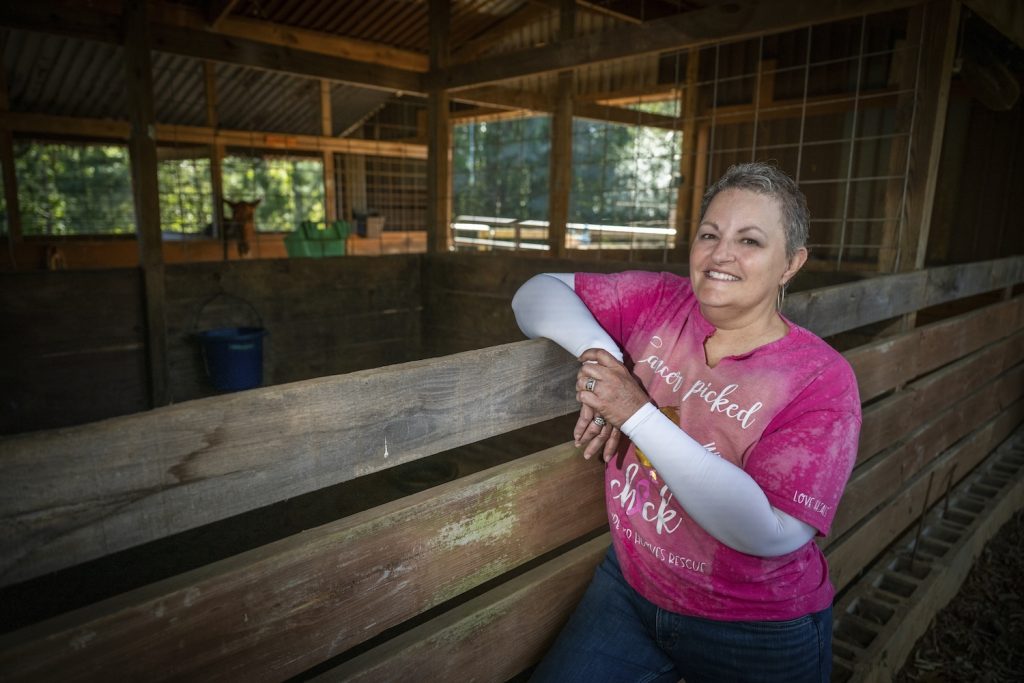
As the owner of an animal rescue farm called Hope for Hooves, which saves horses, ponies, donkeys, sheep, goats and mules, Derrick jokes that she is stubborn as a mule when it comes to beating cancer.
“God has other plans for me,” Derrick said, smiling. “I always tell the devil, ‘Devil, if you’re going to put this on me, I’m going to make you regret it.’”
With all four bouts of cancer, Derrick turned to the team of physicians and surgeons at the Medical College of Georgia and the Georgia Cancer Center at Augusta University for treatment.
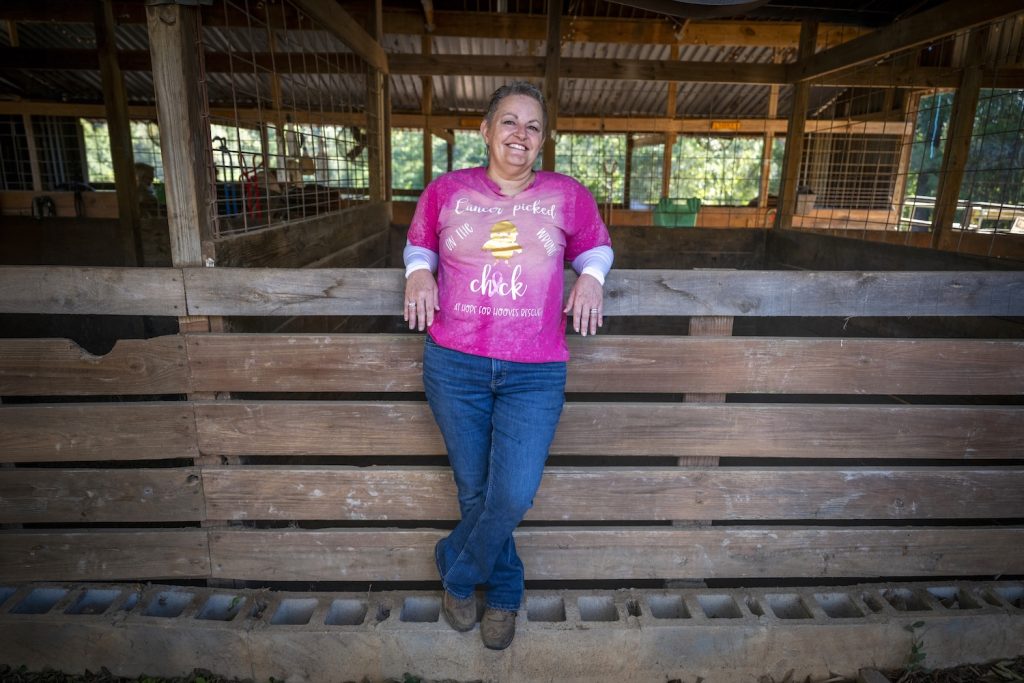
“I owe my life to those doctors. I’m so very thankful for them. They saved my life multiple times.”
Michelle Derrick, a four-time cancer survivor
The Georgia Cancer Center is known throughout the state for operating multidisciplinary tumor boards across nearly every major cancer service line to collaboratively plan patient treatment. For Derrick, she said that kind of extensive, quality care was a game changer in her fight against cancer.
“I owe my life to those doctors,” Derrick said. “I’m so very thankful for them. They saved my life multiple times.”
Never giving up
During her first breast cancer diagnosis approximately 13 years ago, she underwent a mastectomy of her left breast and was declared cancer-free by 2014.
But by 2017, the cancer had returned to her left breast, and through that treatment, she later learned that the cancer had spread to her bones. Her initial diagnosis was not promising, but she immediately began immunotherapy that shrunk the tumor in her breast and was given successful trial medication to treat the cancer.
She vividly remembers the day her oncologist, Mina Aleksan, MD, who was then a fellow at Wellstar MCG Health Medical Center, read her blood test results.
“I woke up that morning and I told my husband, ‘I’m cancer-free.’ And he was like, ‘OK, honey,’” Derrick said, laughing. “And I said, ‘No, you don’t understand. I am cancer-free.’ I knew it so much so that when I went into the phlebotomy room for them to draw my blood, I told the women there, I said, ‘Are y’all going to be here within the next hour? Because the oncologist is fixing to tell me I’m cancer-free.’ And they were like, ‘You go ahead, girl!’”
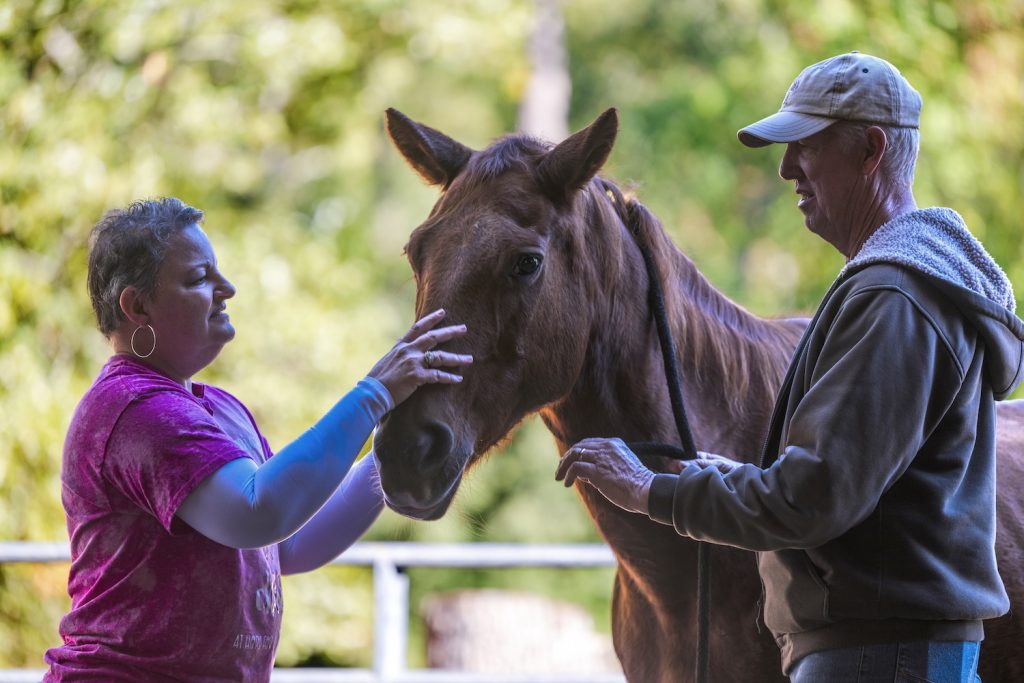
“I asked, ‘Am I healed? Am I considered a miracle?’ And he said, ‘Yes, you are.’ That’s all I needed to know.”
Michelle Derrick, a four-time cancer survivor
Derrick said she just knew that the physicians at the Georgia Cancer Center had saved her life.
“So, I was sitting in the room and Dr. Aleksan walked in and he started reading me the results of my blood test. And I said, ‘Skip to the good part,’” Derrick said, laughing. “I asked, ‘Am I cancer-free?’ And he said to me, ‘According to the physician’s book, you are in remission.’”
Derrick, who is a devout Christian, joked with Aleksan.
“I said, ‘Toss that physician’s book to the side for just a minute,’” Derrick said. “I asked, ‘Am I healed? Am I considered a miracle?’ And he said, ‘Yes, you are.’ That’s all I needed to know.”
A healing hand
Priyanka Raval, MD, an associate professor at the Medical College of Georgia and the co-lead of the breast oncology program at the Georgia Cancer Center, said Derrick became her patient in 2021.
“When I first met her, she was on hormone-reducing therapy,” said Raval, who also directs the breast cancer survivorship program at the Georgia Cancer Center. “She had already heard the words ‘Stage 4 cancer’ before I met her in this journey.”
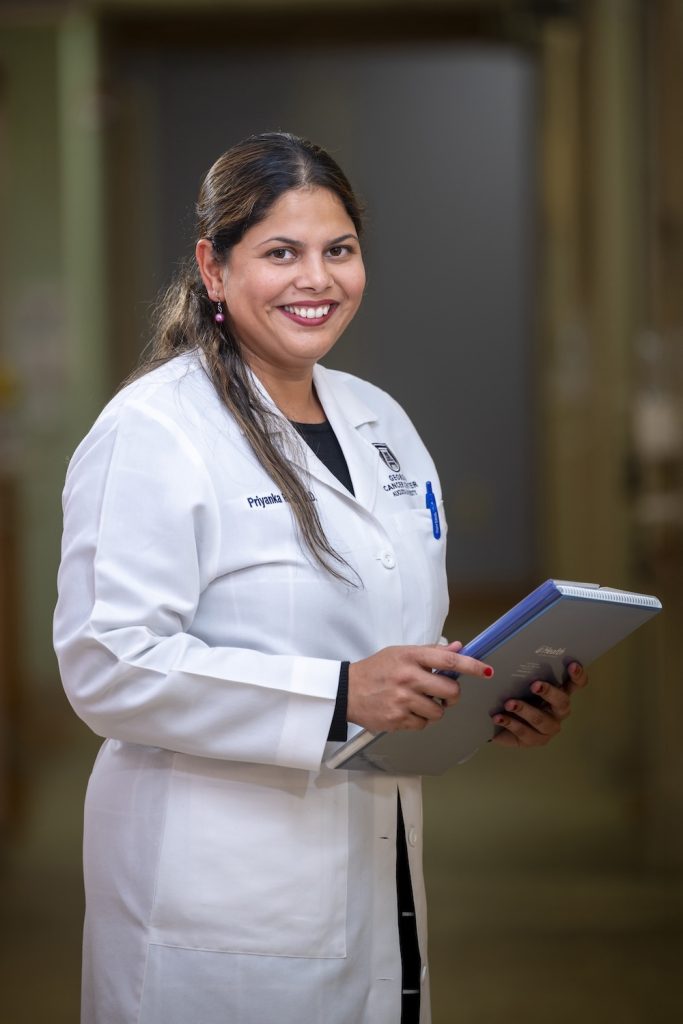
In her third cancer diagnosis, Derrick had a lumpectomy performed by Alicia Arnold, DO, an associate professor at the Medical College of Georgia and a breast surgical oncologist at the Georgia Cancer Center. Derrick began immunotherapy again.
She appeared to be cancer-free, until an MRI in 2025 revealed breast cancer, this time in her right breast.
“As of last year, she was unfortunately diagnosed for the fourth time with cancer and this time it was the exact opposite of what she had been through before,” Raval said. “This time it was a hormone-negative HER2-positive breast cancer. She was treated with what we call neoadjuvant or preoperative chemotherapy. This is one of the more aggressive treatments.”
Derrick went through six rounds of chemotherapy that included two chemotherapy agents and two anti-HER2 therapy agents, Raval said.
“She faced it with a lot of resilience and courage,” Raval said. “In December of last year, she also underwent some heart surgeries while going through all of this. Then, she had her right breast surgery, a lumpectomy, performed by Dr. Arnold. The tumor and area around that were removed and she had radiation to the lumpectomy bed.”
“While it’s very unusual to face and see so many recurrent diagnoses of cancers like Michelle has, with the advent of very targeted therapies and newer therapies available, we have made such strides to treat patients, especially in the breast cancer realm, even in advanced stages.”
Priyanka Raval, MD, an associate professor at the Medical College of Georgia and the co-lead of the breast oncology program at the Georgia Cancer Center
Radiation to the lumpectomy bed, also called the tumor bed, is a targeted treatment given to destroy any microscopic cancer cells that might remain where the tumor was removed, significantly lowering the risk of the cancer coming back, Raval said.
The preoperative chemotherapy treatment was probably the most challenging time of her life, Derrick said.
“I’d always said I would never do chemotherapy, but when your life is on the line, I had to have peace about it,” she said. “I’m going to be honest, that was the hardest thing I’ve ever had to do in my life. The chemo is extremely hard on your body, and you just feel so lifeless. I was literally helpless at times.”
She turned to her faith to get her through those dark days.
“I said, ‘OK, Lord, we’re going one more day,’” Derrick said. “And I just had to remind myself every day, there are only 24 hours in a day. And once we would reach that 24-hour mark, I was like, ‘OK, I can do it again.’ Every day I felt myself getting stronger and stronger. And here I am today, cancer-free and I feel great.”
Not just a patient
The physicians and surgeons at the Georgia Cancer Center supported Derrick every step of the way, she said.
“Dr. Raval from Augusta University has been absolutely amazing,” Derrick said. “She’s gotten to see first-hand some miracles. I am extremely thankful for all the doctors at AU. Not only were they there for me medically, but they were there for me emotionally.”
“I knew that I could go in there and they were my safe place,” she added. “I could cry and they understood. They didn’t judge me in any way, shape or form. They totally understood where I was coming from.”
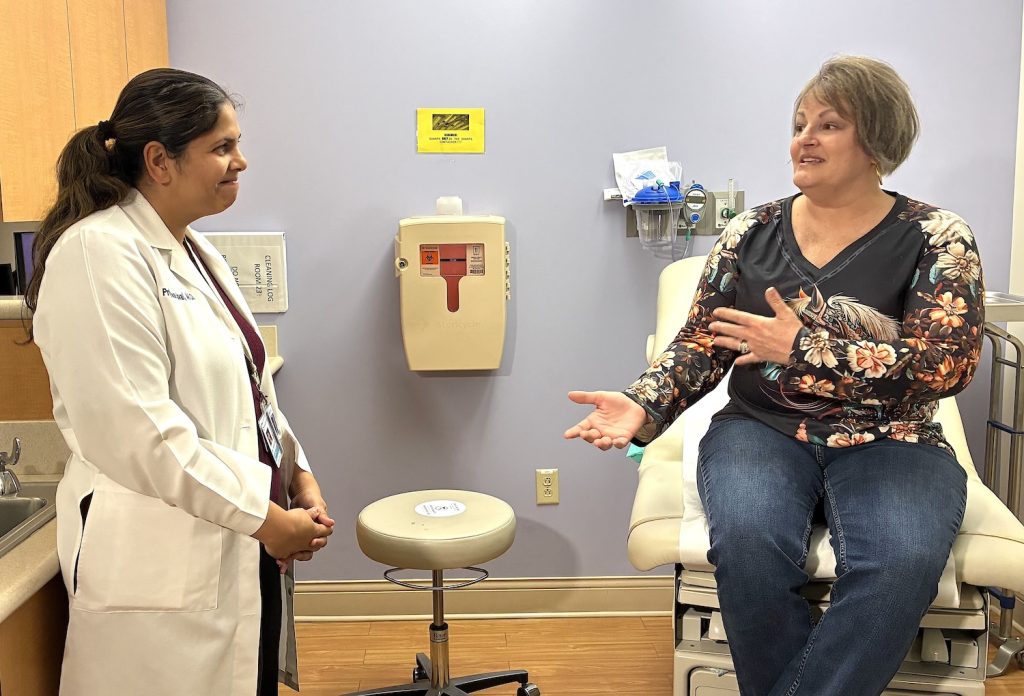
“Dr. (Priyanka) Raval from Augusta University has been absolutely amazing. She’s gotten to see first-hand some miracles. I am extremely thankful for all the doctors at AU. Not only were they there for me medically, but they were there for me emotionally.”
Michelle Derrick, a four-time cancer survivor
The physicians and surgeons at the Georgia Cancer Center treated her as a person, not just a patient, Derrick said.
“I remember my oncologist was on vacation with his family, and he called me one day and said, ‘Michelle, I know that you hate to do MRIs, but I’m asking you from me, I want you to have one,’” Derrick said. “He told me, ‘I just feel like you need to do one.’”
Derrick pushed back at first, but the doctor insisted.
“I said, ‘I’m going to do it only because you want me to,’” she said. “That’s when they found the cancer on my right side. He means so much to me because he saved my life.”
Raval said the Georgia Cancer Center’s multidisciplinary tumor boards work as a team to best treat the patient.
“While it’s very unusual to face and see so many recurrent diagnoses of cancers like Michelle has, with the advent of very targeted therapies and newer therapies available, we have made such strides to treat patients, especially in the breast cancer realm, even in advanced stages,” Raval said. “So, with such strides in medical oncology and collaborative care with our other colleagues in radiation oncology and breast surgery, patients can live very meaningful lives like Michelle.”
‘Cancer can be cured’
Derrick said the healing environment of her 10-acre animal rescue farm in Edgefield County, her faith in God and the dedication of the doctors at the Georgia Cancer Center are all why she is still here today.
“I remember the day that I was told that I had three months to live,” Derrick said, adding that she turned to God for help. “I was like, ‘God, I don’t want to die. I’m not ready to go.’”
She said she was instantly given a message.
“God told me, ‘I want you to be just like the donkey and face adversity. Don’t run. Don’t be scared,’” Derrick said, smiling. “Because if you know anything about equines, which are horses, donkeys, mules and all of that, they are a flight or fight animal. Normally, a horse will flee. If they see something like a bear, they’re going to run. Whereas a donkey, they’re going to stand strong. They won’t move. They will face it head on. They will say, ‘Come at me. I’m not afraid of you.’ And so, I learned to stand strong against cancer.”
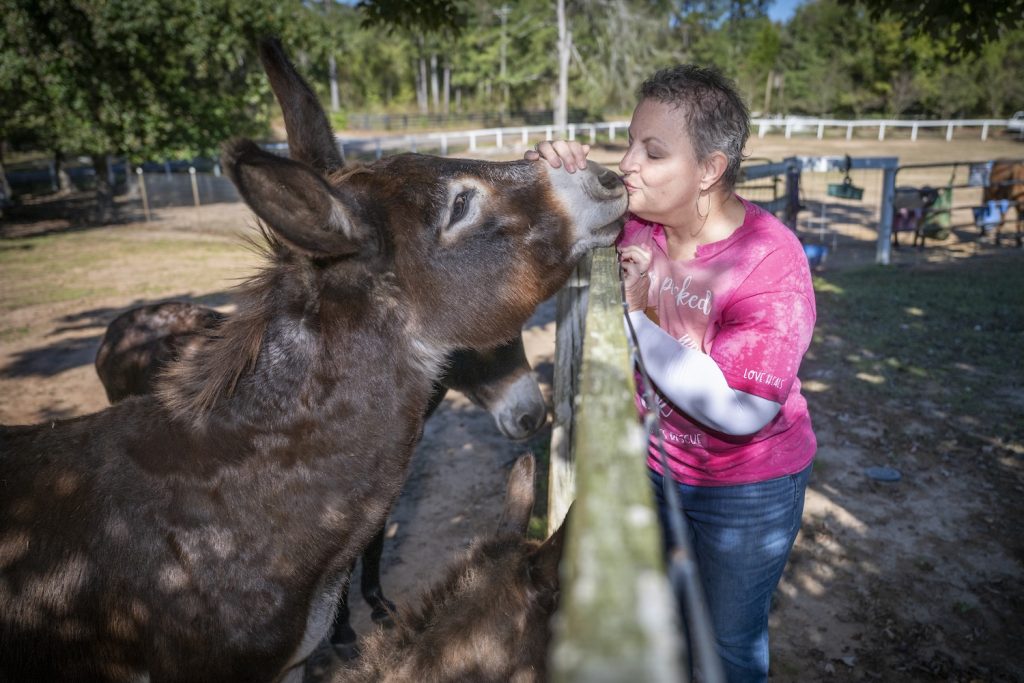
“God told me, ‘I want you to be just like the donkey and face adversity. Don’t run. Don’t be scared.'”
Michelle Derrick, a four-time cancer survivor
Raval has been so inspired by Derrick’s strength and resilience against cancer that together they are planning a future breast cancer support group meeting at Derrick’s animal rescue, Hope for Hooves.
“Michelle has shown that despite facing cancer so many times, she chose what she felt was right for her and she is here to tell her story,” Raval said. “I’m incredibly honored and proud to say that we could be a part of her cancer journey. We at MCG and Wellstar Georgia Cancer Center are a multidisciplinary team. And given that we are an academic center with access to clinical trials and same-day physician visits where she could actually see all of us, the breast surgeon, the medical oncologist and the radiation oncologist all under one roof, made it very collaborative in her benefit.”
“We are a part of a big team here that serves people like Michelle,” Raval added. “It takes an entire team.”
Lyle Hickman, MD, a hematology and oncology fellow with Georgia Cancer Center and Wellstar MCG Health, has been helping to treat Derrick for the past several months along with Raval.
“I have been caring for Ms. Michelle Derrick for the last five months and she completed her treatment for HER2-positive breast cancer,” Hickman said. “During this time, she has been upbeat, resilient and determined to win this fight. She has mentioned her trust in God and how this has helped her face each diagnosis of recurrent breast cancer with unwavering determination.”
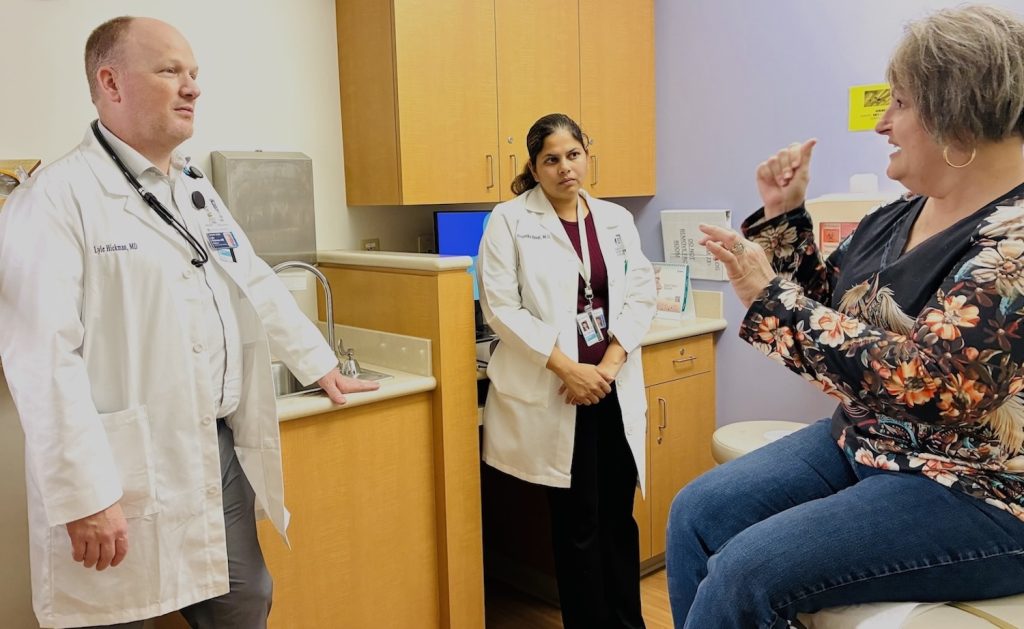
“During our discussions, Ms. (Michelle) Derrick said she does not like to draw attention to herself, but during this journey, she has embraced the chance to share her story and help other women in their journey with breast cancer. She is an example of charity and love even during the hard times.”
Lyle Hickman, MD, a hematology and oncology fellow with Georgia Cancer Center
With the support from her husband, daughters and the animal rescue, Derrick has been able to focus on others in need, even while undergoing cancer treatment, Hickman said.
“At one of our appointments, she was wearing a shirt that said, ‘It is well with my soul,’” Hickman said. “What a statement given the trials that she has had and is facing.”
“During our discussions, Ms. Derrick said she does not like to draw attention to herself, but during this journey, she has embraced the chance to share her story and help other women in their journey with breast cancer,” Hickman added. “She is an example of charity and love even during the hard times. I look forward to continuing to help in her care during this cancer journey.”
Raval agreed that it requires the patient’s strength and willingness to listen to expert medical advice to make their own decisions about future treatment.
“Michelle has done everything that she could have done from her standpoint. She asked the right questions, she advocated for herself, and she shared her story as well to make other people aware of what they can do for their own care,” Raval said. “With each cancer that Michelle has seen over the years, the amount of information that we have given her each time has been a lot. The fact that she has digested it all in steps and asked the questions, taken time to make the decisions that were right for her and her family, leaned on faith at times when she needed it and found support in her family and friends in order to come back and say, ‘Yes, I will go through this one more time,’ is incredible.”
Raval said she looks forward to working with Derrick in the future to inspire other breast cancer patients not to be afraid of a cancer diagnosis.
“The fact that Michelle would come to the clinic with a smile on her face says a lot about her resiliency and the courage that she’s shown,” Raval said. “Despite cancer having been a part of her life for a long time, she’s seen newer treatments that have challenged her body and challenged her mind. But she’s still here with a smile sharing her story, leaning on things that make her think of the positive.”
“That’s truly inspiring to us in the work we do because one in eight women will face breast cancer diagnosis at some point in their lives,” Raval added. “The prevalence of breast cancer is high, but if caught early, it can save lives. That’s why we want to spread the word: Cancer can be cured.”

 Aaron Smith
 Erin Weeks
 Jennifer Hilliard Scott