 Augusta University
 Jennifer Hilliard Scott
A gene previously linked to coronary artery disease risk appears to serve as a powerful protector of the heart’s arteries, according to researchers at the Medical College of Georgia at Augusta University.
In a new study published in Circulation, researchers in MCG’s Vascular Biology Center found that loss of the gene LMOD1 triggered rapid plaque buildup in coronary arteries, helping explain why some people may be genetically more susceptible to heart disease than others.
Coronary artery disease, the leading cause of death world-wide, is caused by atherosclerosis, a process in which fatty plaques accumulate inside arteries that supply blood to the heart. While high cholesterol, inflammation, high blood pressure and smoking are well-known risk factors, the new study further supports a genetic basis for coronary artery disease and highlights the growing importance of a specific cell type (smooth muscle) within the artery wall itself in resisting disease.
“Our findings suggest that LMOD1 functions as an important artery-protective gene,” said Joseph Miano, PhD, J. Harold Harrison, MD, distinguished university endowed chair in Vascular Biology and the study’s lead investigator. “When this protective mechanism is lost, coronary arteries become highly susceptible to rapid cholesterol-driven plaque buildup.”
Earlier studies from the Miano lab showed that LMOD1 plays a vitally important role in smooth muscle tissues of the bladder and gastrointestinal tract. To better understand its role in the smooth muscle cells of blood vessels, researchers developed a method of deleting the gene only in vascular smooth muscle cells, leaving LMOD1 largely intact within smooth muscle cells of the bladder and gastrointestinal tract.
“It’s important to understand that what we see in humans is an association, not proof of causation,” Miano said. “The question has always been whether LMOD1 is actually doing something important in the artery wall that affects disease risk.”
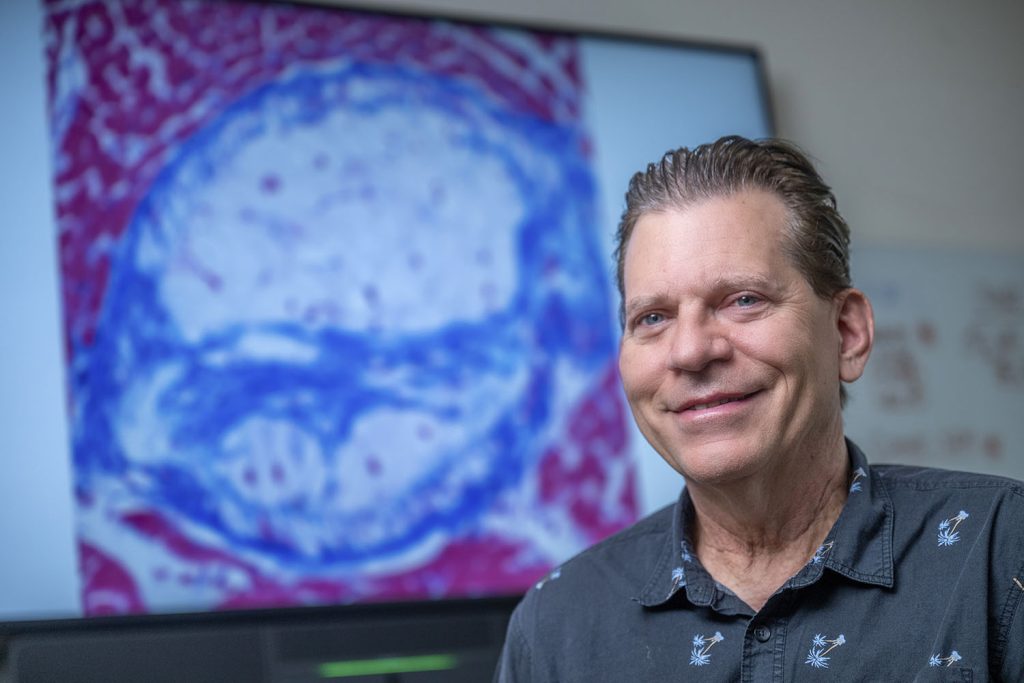
To answer that question, researchers developed a model that allowed them to remove LMOD1 only from vascular smooth muscle cells, which help maintain blood vessel structure and function.
When those animals were exposed to a high-fat diet, the results were striking.
Mice lacking LMOD1 developed severe coronary artery disease, with plaque formation appearing within days and becoming well established within a few weeks.
“That was one of the most surprising findings,” Miano said. “Coronary atherosclerosis is exceedingly rare in mice and previous reports indicated a much longer time frame for the plaques to develop.”
Unlike humans, mice carry most of their cholesterol in high-density lipoproteins, or HDL, commonly known as “good cholesterol,” making them naturally resistant to coronary artery disease.
Using electron microscopy and cell-tracing techniques, the researchers found that smooth muscle cells migrated into developing plaques and accumulated cholesterol. Nearly half of the cells within the plaques originated from the artery wall itself.
“We could actually see smooth muscle cells moving into areas where plaques were forming,” Miano said. “They appear to be responding to changes in the vessel wall, but in doing so they contribute to lesion development.”
The findings challenge the traditional view that atherosclerosis is driven primarily by circulating cholesterol and inflammation.
“These data suggest that the health and function of artery wall cells themselves are critical determinants of whether plaque develops,” Miano said. “LMOD1 appears to help these cells resist becoming overwhelmed by cholesterol.”
Researchers also found evidence that smooth muscle cells may play both harmful and protective roles during disease progression. While some cells contributed to plaque growth, others appeared to help form the fibrous cap, a protective layer that stabilizes plaques and reduces the risk of rupture and heart attack.
Another unexpected finding involved LMOD1 itself. Scientists had believed the gene’s protective effects were tied to its role in organizing actin, a key component of a cell’s internal structure. However, the team found that a modified version of LMOD1 that lacked this function still protected against coronary artery disease.
“The gene is clearly doing more than we previously understood,” Miano said. “Identifying that additional function could open new avenues for understanding and potentially preventing cardiovascular disease.”
The study also helps explain earlier human genetic findings associating DNA variants near LMOD1 to increased coronary artery disease risk and provides a foundation for future research into the gene’s role in human heart disease.
The discovery could point to new approaches for preventing and treating coronary artery disease. Most current therapies focus on lowering cholesterol, controlling blood pressure or reducing inflammation. The new findings suggest maintaining the health of the artery wall itself may offer another way to combat atherosclerosis.
The research also has implications for precision medicine. More than 300 genetic variants have been associated with coronary artery disease risk and are increasingly being incorporated into polygenic risk scores designed to estimate a person’s inherited susceptibility to the disease.
“LMOD1 is one piece of a much larger genetic puzzle,” Miano said. “By understanding how genes like LMOD1 influence coronary artery disease, we will improve our ability to identify people at elevated risk before clinical symptoms appear. In addition, given the rapid manifestation of coronary disease in this model, we will be able to test various therapeutic approaches to mitigate disease in a much shorter time interval.”


 Hannah Litteer
 Jaylon Brooks
 Morgan Hayes
 Tyler Wooten