 Augusta University

 Felicia Baskett
Students at Augusta University will soon have a new opportunity to receive financial support while gaining the skills needed for careers in cybersecurity and artificial intelligence.
The School of Computer and Cyber Sciences received a $2 million grant from the National Science Foundation under the Artificial Intelligence and Cybersecurity Education Innovation and Scholarship for Service Program.
The award supports scholarships under the project Augusta University Government-Ready Experts in Resilient CyberAI (AUGER CyberAI).
Michael Nowatkowski, PhD, is the principal investigator. Co-PIs include: Ahmed Aleroud, PhD, Jeffrey Morris, PhD, Piotr Krysta, PhD, and Gurismran Walia, PhD.
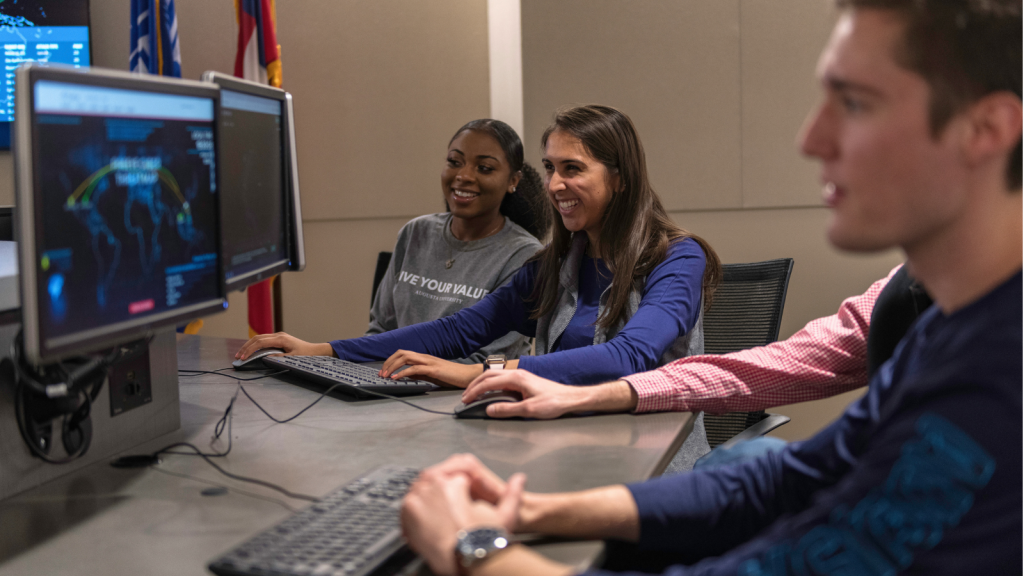
This new NSF Scholarship for Service award marks a new chapter with the integration of cybersecurity and artificial intelligence.
“This is our second Scholarship for Service grant. We had a previous grant from 2021 to 2026 that we still have two students in now. We had a total of 24 students in our previous grant,” Nowatkowski said.
Nowatkowski explained that the goal behind pursuing the grant was to help offset the cost of students’ education while preparing graduates to bring cybersecurity and artificial intelligence expertise to the federal government.
Under the grant requirements, participating undergraduate, master’s and doctoral students must take at least four cybersecurity courses and two artificial intelligence courses.
Nowatkowski said AI must be strongly connected to cybersecurity, both as a tool to strengthen cybersecurity and as technology that has to be secured.
For students, that means AI will play a greater role in their cybersecurity education.
“We’re starting to revamp our courses and adding an AI component to courses that aren’t normally AI-focused,” said Morris.
One example is CYBR 3200, Cyber Network Defense and Counter Measures. Instead of adding a standalone AI module, Morris said faculty plan to weave AI throughout the course, allowing students to examine how the technology affects areas including governance, personal security, passwords and other cybersecurity topics.
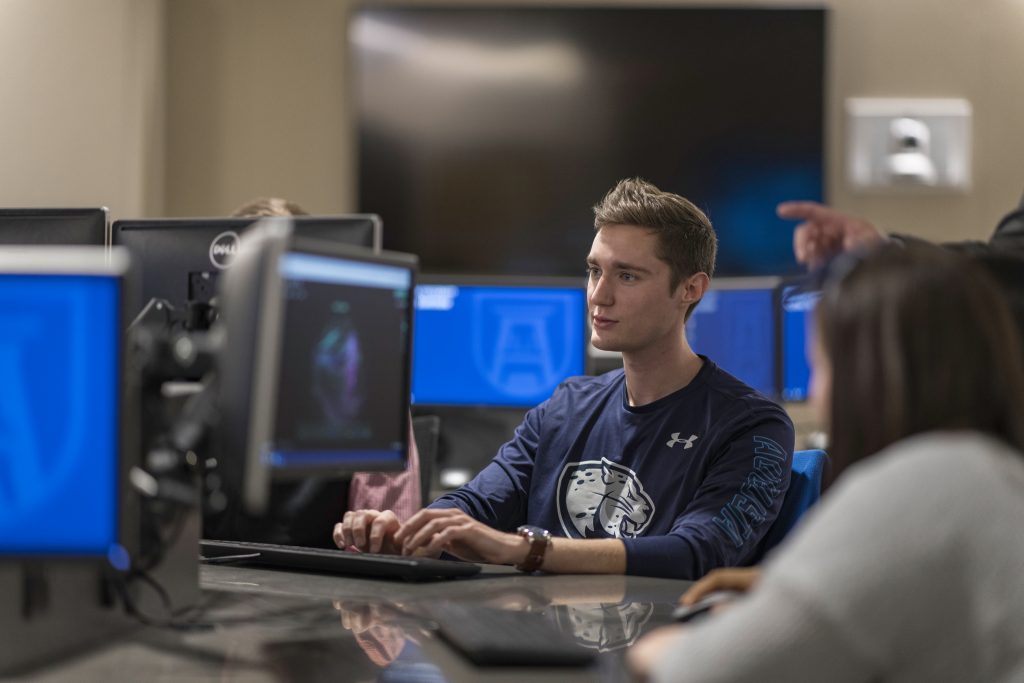
“Our students will be learning as much cutting-edge technology as we can get to them to prepare them to walk out the door to be successful in their careers,” said Morris.
Along with preparing students for a changing cybersecurity workforce, the program will provide significant financial support. Students receive up to three years of funding which will cover tuition and fees, along with an annual stipend of $27,000 for undergraduate students and $37,000 for graduate students.
“It removes the burden of educational debt and the concern of ‘How am I going to pay for all of this?’ that some students have,” said Morris. “It gives them a chance to have their education paid for. They can concentrate on learning.”
The program’s substantial scholarship support requires that upon graduation, students work for an agency within the federal executive branch of the United States government for the same number of years they received funding. If students are unable to find employment within the federal executive branch, they can fulfill the service obligation by working for state or local government agencies.
Nowatkowski said the goal is for graduates to enter government positions where they can use their expertise in cybersecurity and artificial intelligence.
“This award is an exciting opportunity for our students and an important recognition of the strength of academic programs in the School of Computer and Cyber Sciences,” said Alex Schwarzmann, PhD, dean of the School of Computer and Cyber Sciences. “As cybersecurity and artificial intelligence become more interconnected, we have a responsibility to prepare students with the knowledge and experience needed to meet the evolving needs of the workforce. AUGER CyberAI allows us to invest in our students and mentor the next generation of professionals prepared to serve our nation.”
Applications are now open for the first AUGER CyberAI cohort, which will begin in fall 2026. Approximately seven students will be recruited for the first cohort with another seven expected to be recruited for 2027.

 Jamison Guice
 Miguelangelo Hernandez
 Jennifer Hilliard Scott
 Stacey Eidson