 Augusta University


 Lindsey Morris
Research that has been a decade in the making for three members of the Georgia Cancer Center may lead to improvements in the current treatment of pancreatic cancer.
“We started this research with leukemia cells years ago,” said Nahid F. Mivechi, PhD, professor in the Department of Radiation Oncology at the Medical College of Georgia at Augusta University. “It has come quite far since then.”
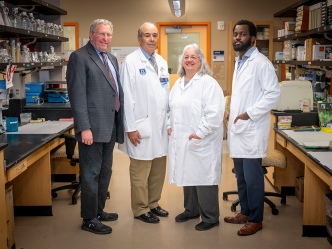
Mivechi, along with two colleagues, Xiongjie Jin, PhD, assistant professor in the Department of Radiation Oncology and Dimitrios Moskofidis, PhD, MD, a professor in the Department of Medicine, have recently been awarded a grant from The National Institutes of Health/National Cancer Institute.



The grant, supported in part by PACELINE, is for five years and totals $2.8 million. It will support the continuation of their work recently published in the Journal of Cell Biology.
Transcription factors regulate gene expression, which is how the information is encoded in a gene and is used to produce a functional gene product, like a protein. They are not DNA, but they sit on the DNA of genes, many of which are involved in tumor growth and proliferation.
There is a critical unmet need for novel therapeutic approaches to overcome key barriers in management of pancreatic cancer. The team is currently investigating whether targeting the Heat Shock Transcription Factor 2 (HSF2)-Heat Shock Protein 110 (HSP110) axis to modulate transcription of genes can sensitize pancreatic tumor cells to radiation therapy and enhance anti-tumor immune responses, providing a new avenue for pancreatic cancer therapy. Both belong to the cellular defense mechanism that protects cells from protein damage caused by elemental stressors, called the Heat Shock Response.
The stress response in cells that is regulated by these factors greatly affect cellular function that is critical in the development of cancer.
When cancer cells are formed from abnormal or damaged cells, they grow and multiply, invading different areas of the body. This causes disruption in the body, including damage to DNA in the cells, deregulates transcription factors and causes a weakened immune system. The body needs assistance in killing cancer cells, which is where current treatments, such as chemotherapy, radiation, and immunotherapy, come into play.
However, pancreatic tumors are aggressive, with several underlayers of therapeutic resistance to current treatment methods, making it incredibly difficult to treat.
The loss of HSF2 transcription factor sensitizes cells to radiation treatment and can potentially improve immunotherapy treatments of solid tumors such as pancreatic cancer.
“Based on the team’s observation, it is hypothesized that the disruption of HSF2-HSP110 axis impairs adaptive transcriptional responses, sensitizes tumor cells to genotoxic therapies, and enhances anti-tumor immunity, which results in vulnerability in the solid tumor,” Mivechi said.
The prediction is that the successful completion of this study will establish novel therapeutic strategies for treating pancreatic tumors through simultaneous induction of transcription stalling, splicing impairment, immunomodulation and tumor cell-specific radiation sensitivity.


 Aaron Smith

 Stephanie Hill
 Felicia Baskett
 Jennifer Hilliard Scott