 Augusta University

 Milledge Austin
Researchers from the Immunology Center of Georgia, part of the Medical College of Georgia at Augusta University, recently published a review in a recent issue of Nature Reviews Cardiology that clarifies how a specific type of immune cells known as CD8+ T cells contributes to the development and progression of atherosclerosis.
Atherosclerosis is characterized by the slow buildup of plaque inside arterial walls, which thickens and narrows the arteries and restricts blood flow. When that plaque ruptures, the resulting blood clot causes a heart attack or stroke.
According to the World Health Organization, cardiovascular diseases remain the leading cause of death globally, with nearly 18 million people dying each year. According to the team’s study, more than 600 million cases are reported globally each year, many of which result from atherosclerosis.
The study, titled “CD8+ T cells in atherosclerosis and coronary artery disease,” highlights that CD8+ T cells actively contribute to atherosclerosis from the earliest stages of the disease rather than acting as passive bystanders.
“This study is important because it highlights the major role of CD8+ T cells in atherosclerosis and their potential impact on cardiovascular diseases such as myocardial infarction and stroke,” said Hossam Abdelsamed, PhD, assistant professor at the IMMCG who served as the senior corresponding author on the article. “The review discusses the possibility that CD8+ T cells can either worsen or protect against plaque development, depending on the disease stage and cell subtype. It also emphasizes how advanced technologies, such as single-cell sequencing, spatial transcriptomics and organoids can improve our understanding of CD8+ T cell immune responses in atherosclerosis. Importantly, the study identifies key research gaps and suggests that targeting harmful CD8+ T cell responses could lead to new immune-based treatments for cardiovascular diseases.”

The study, which took nearly a year and a half to complete, found extensive research on CD4 T cells, but identified a major gap in studies on CD8+ T cells despite their presence as one of the most clonally expanded immune cell populations in atherosclerotic plaques. clonally expanded immune cell populations in atherosclerotic plaques.
The team of the study involved Abdelsamed’s postdoctoral fellows Ishita Tandon, PhD, the article’s first author, and Alaa M. Khalifa, PhD; as well as Hadeer Soliman, a former research associate in Abdelsamed’s lab; Mohamed Yosri, PhD, a professor at Al-Azhar University in Cairo, Egypt; and Klaus Ley, MD, co-director of IMMCG and Georgia Research Alliance Eminent Scholar and professor of physiology.
The study explains that both the innate and adaptive immune systems play crucial roles in the progression of atherosclerosis. While CD8+ T cells are the most clonally expanded adaptive immune cells in human atherosclerotic plaques, research still don’t fully understand whether these cells promote or protect against atherosclerosis during the different stages of the disease.
“Depending on their subtype and stage of disease, our study looks at how these cells may either promote inflammation and plaque instability or help protect against disease progression,” Abdelsamed said. “The review summarizes current knowledge about the phenotypic, functional and transcriptional characteristics of these cells, as well as the influence of comorbidities such as aging, obesity and diabetes. It also highlights major unanswered questions and explores how targeting CD8+ T cells could lead to new immune-based therapies for cardiovascular disease.”
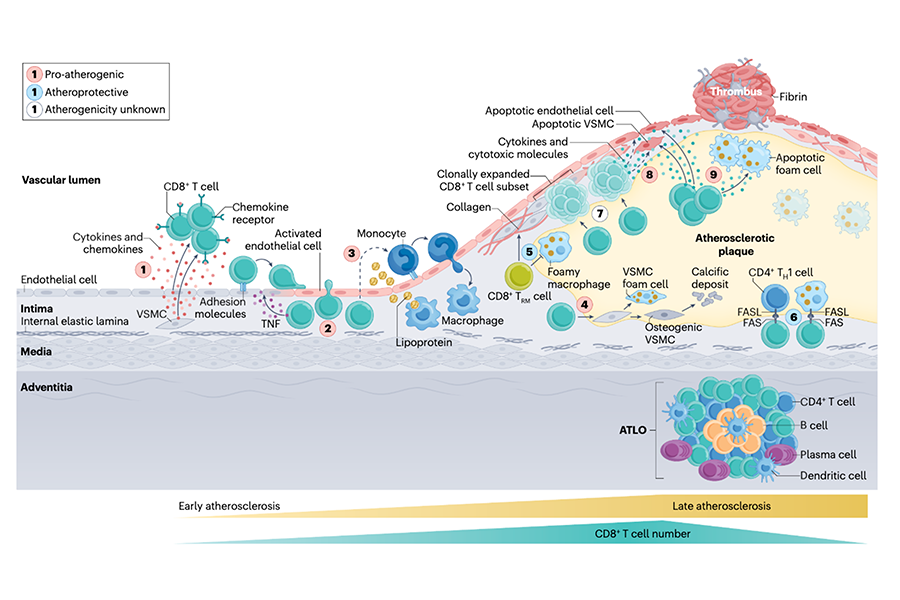
In their review, Abdelsamed’s team found that CD8+ T cells enter atherosclerotic plaques early in the disease process and continue to expand as the disease progresses. As plaques advanced these cells become more abundant and cluster within organized immune structures. Molecular signals direct the movement of these cells into and within the plaques, helping them remain in place and form concentrated areas of immune activity inside the affected vessels.
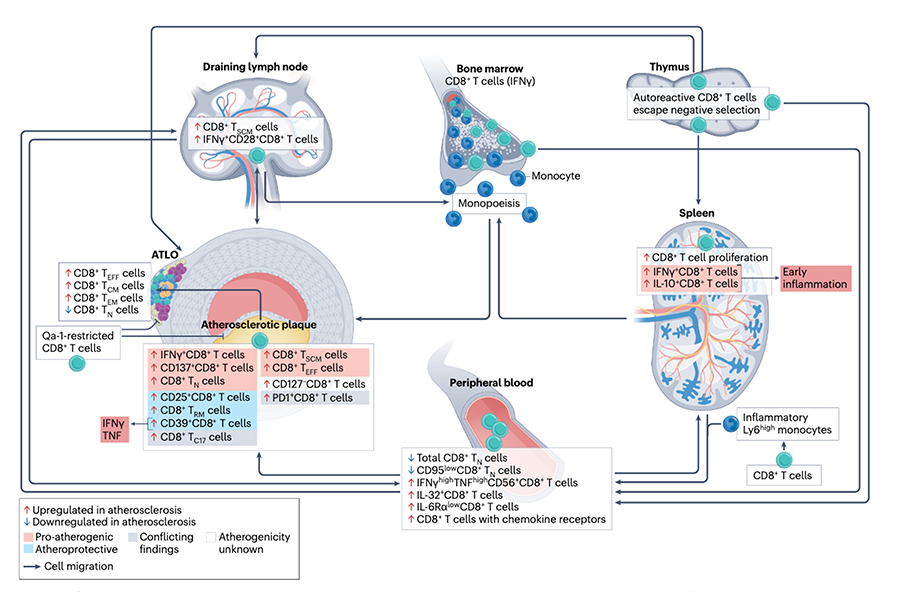
Once inside the plaque, many CD8+ T cells become highly activated after encountering specific triggers linked to past infections like influenza and other common viruses. These activated cells release inflammatory and tissue-damaging molecules that weaken the plaque and increase the risk to rupture, a major cause of heart attacks. They can also recruit additional immune cells and influence changes in the artery wall that contribute to disease progression. However, not all CD8+ T cells are harmful, as some subsets play a protective role by reducing inflammation and limiting the activity of other immune cells that would otherwise worsen plaque development.
The findings highlight the dual role of CD8+ T cells in atherosclerosis, where they act as both drivers of inflammation and potential regulators of the disease. Insights from related conditions, such as autoimmune diseases, cancer and diabetes, suggest that there might be ways to better control these cells. Abdelsamed and his team acknowledge that this study raises more questions and will lead to further research.
“We have a lot to do. One obvious missing thing is the characterization of self-reactive CD8+ T cells in atherosclerotic patients where we will be looking for their gene expression signature and clonality at single cell level,” Abdelsamed said.
Since viral infections are strongly linked with cardiovascular diseases, the team plans to examine the degree of cross-reactivity between self (ApoB-reactive) and non-self (viral-reactive) CD8+ T cells as well as the bystander activation of the viral-reactive CD8+ T cells.
“The ApoB-reactive CD8+ T cells are only the tip of the iceberg,” Ley said. “We are developing methods for unbiased discovery of self-reactive T cells to better understand the autoimmune aspect of atherosclerosis.”
“The killing capacity of these antigen-specific CD8+ T cells is still unknown,” Abdelsamed said. “To examine the autoimmune component of these cells, we will integrate our sequencing datasets with published data of autoreactive T cells. Indeed, Dr. Tandon started to generate data and write a manuscript to further fill in the above-mentioned knowledge gaps.”
Future research will focus on identifying other specific antigens and molecular pathways that drive CD8+ T cell activation in atherosclerotic plaque as well as crosstalk between CD8+ T cells and other immune and non-immune cells using advanced tools such as single-cell sequencing and spatial transcriptomics. The team hopes these findings will support the development of targeted immune-based therapies aimed at reducing plaque inflammation, preventing plaque rupture and lowering the risk of cardiovascular diseases like myocardial infarction and stroke.


 Stacey Hudson

 Felicia Baskett
 Karen Fulton