 Augusta University

 Hannah Litteer
Medical expenses are one of the most common sources of credit to U.S. households, with medical debt affecting at least 36% according to 2024 data.
Not only does this carry a significant financial burden, but it could also contribute to negative psychological and even physical impacts for those facing medical indebtedness.
In his recently published study in Sleep Epidemiology, “Medical debt and insufficient sleep among U.S. adults,” Biplab Datta, PhD, an assistant professor in the Department of Health Management, Economics and Policy within the School of Public Health at Augusta University, worked with Murshed Jahan, PhD, an assistant professor of economics at Valdosta State University to uncover the link between medical debt and insufficient sleep.

“I was interested to see how medical indebtedness, which is kind of a cycle of disadvantage, may impact population health outcomes,” Datta explained. “People seek medical care when they are in bad health, then they get a bill that they cannot pay, then the burden of medical debt makes them stressed, which contributes to poorer health, and the cycle continues.”
To determine whether medical debt has any association with sleep health, Datta first had to lay the groundwork for his study. He kept the focus on family-level medical debt in multiple waves of National Health Interview Survey data; defined insufficient sleep as less than or equal to six hours in a 24-hour period; included adults from different generations in the analytical sample and focused on time periods pre- and post-Affordable Care Act and after COVID-19.
“Any kind of debt is associated with stress, and stress is associated with sleep deprivation, or insufficient sleep. We wanted to connect the dots – medical debt, to stress, to potential health outcomes such as sleep deprivation,” Datta said.
Keeping in mind that both medical debt and sleep health are connected to socioeconomic status, he alleviated confounding influences by conducting separate studies across different income levels. He followed that with random-effect meta-analyses to estimate the overall association between medical debt and insufficient sleep for each generation in different time periods. He then checked the robustness of the association by performing analyses for the sub-samples separated by sex.
“We accounted for the variables that can potentially influence sleep, and, at the same time, can also influence medical debt,” Datta emphasized. “If we do not adjust for variables that have a joint influence on sleep health and medical debt, our results could be biased. Even though we account for many of these variables, we cannot claim that the list is exhaustive and, therefore, we cannot say medical debt causes insufficient sleep, just that it is associated.”
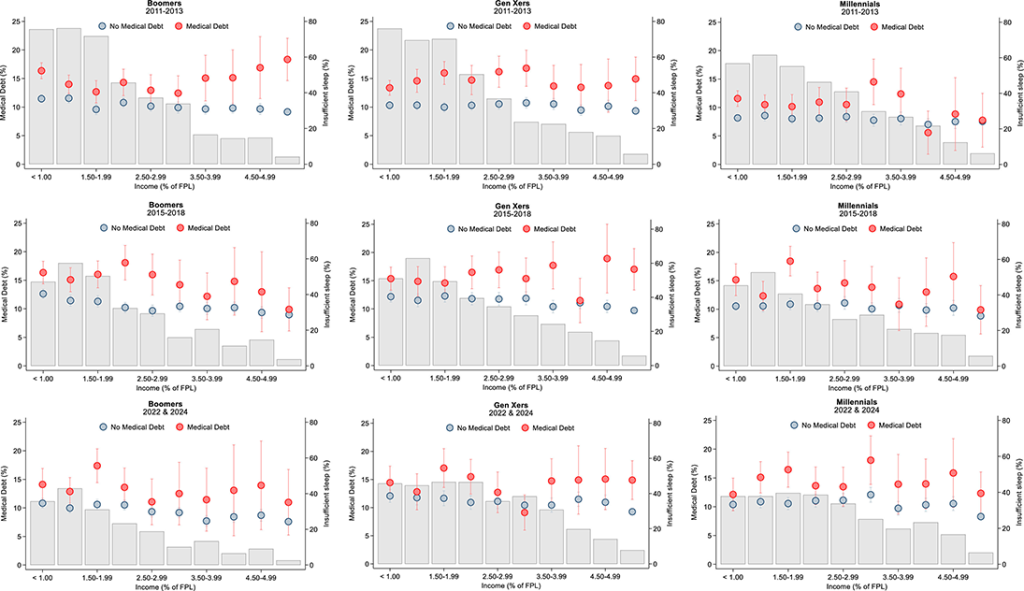
After the due diligence and data analysis, the results showed that for all generations and time periods, the prevalence of insufficient sleep was higher among those with medical debt. In the pre-Affordable Care Act period, Boomers, Gen Xers and millennials with medical debt were 1.52, 1.57 and 1.41 times more likely to have insufficient sleep. After the Affordable Care Act was passed, the odds were 1.51, 1.56 and 1.47 and 1.46, 1.33 and 1.51 after COVID-19, respectively.
Datta explained there are two major implications for these findings.
The first is that targeted interventions aimed at improving sleep health can be offered to people with medical debt.
The second is more difficult and would take more time to implement.
“This implication is much broader, and that’s figuring out what can be done both in short- and long-term to mitigate the burden of medical debt,” Datta said. “While I think more research is needed in that aspect, the important first-step is to acknowledge that this is a population health problem.”
Datta hopes this research will be used as a stepping stone for legislators to come up with a solution for the medical debt issue, and through that, its various negative psychosocial and health effects.
“We all know medical debt is bad, but when we want our policy makers to do something, it’s important to give them some facts and context to begin with. I think this paper provides some talking points that may facilitate moving forward with needed policy dialogues and actions,” Datta explained. “If there are two individuals and one has medical debt and one doesn’t, the individual who has medical debt has a higher likelihood of having sleep disturbance. That is the background information for future research and for more policy talks.”


 Haley Crain
 Jennifer Hilliard Scott
![Participants listen and engage during the Connected for Life Open-House event. [Aaron Smith/Augusta University]](https://jagwire.augusta.edu/wp-content/uploads/sites/15/2026/10/DSC_9186-332x249.jpg)
 Aaron Smith
 Stacey Hudson