Augusta University
 Paige Tucker
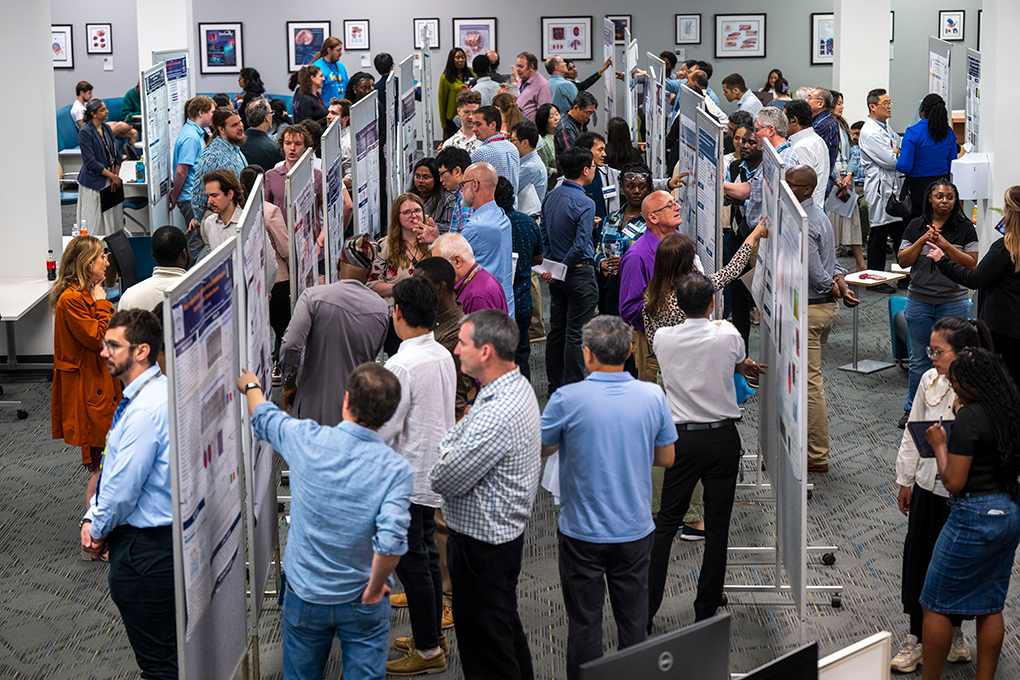
More than 200 researchers participated in the 41st annual Augusta University Graduate Research Day, topping previous participation levels and reflecting consistent growth.
Two hundred two graduate students and postdoctoral fellows participated. They presented 190 posters, and 12 postdocs were selected to give oral presentations. All 11 of AU’s colleges and schools were represented this year among the numerous rows of abstract posters on display on – for the first time – two floors of the Robert B. Greenblatt, M.D. Library.
“I think it’s just an amazing testament to the growth that we’ve had at the institution and the commitment to growing research. As the health sciences campus of the University System of Georgia, we have strong research programs,” said Jennifer Sullivan, PhD, dean of The Graduate School. “This really gives our students, our faculty, our leadership and community members an idea of what that really means. When you talk about research, people have an idea about what that is, but the fact that it spans disciplines – there’s educational research, there’s human and social sciences research. There’s public health research, biomedical research. What research looks like is different in each of those spheres, but we have expertise and students who are really delving into lots of the problems we’re facing as a nation and in Georgia to help advance our understanding and come up with new solutions.”
Graduate students are encouraged to participate in Graduate Research Day, even if their research is in its earliest stages.
“We could have a sixth- or seventh-year student participating next to a student who’s really only been doing research for one or two semesters. Part of what I love about that is they get to learn from one another. Both of those students will have a wonderful story at the end of the experience and will be able to see how their research can develop over time,” Sullivan said.
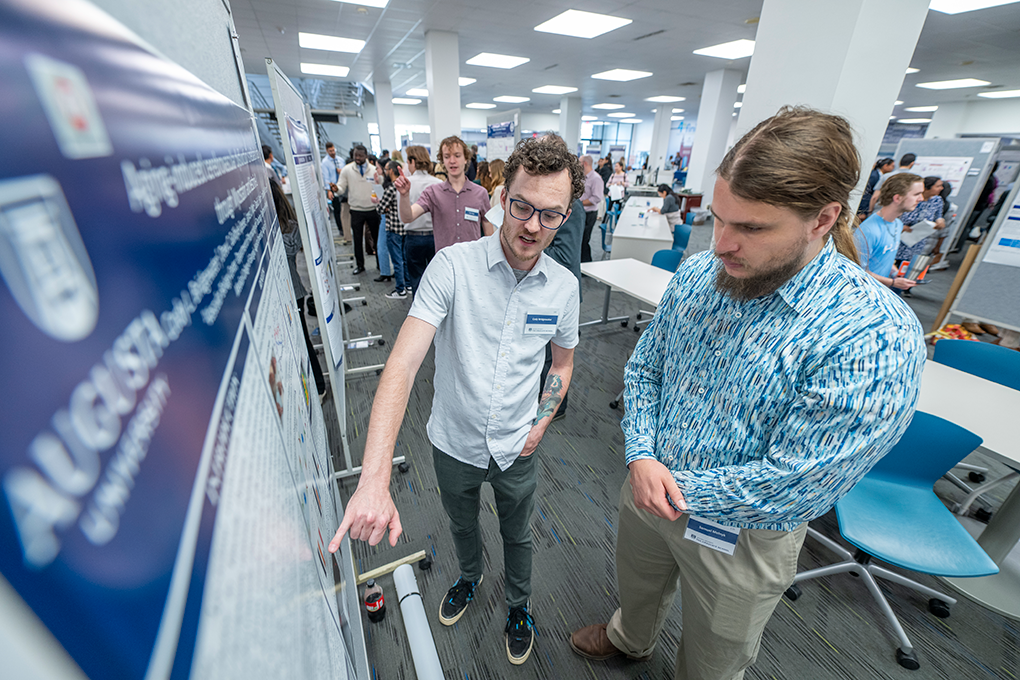
Lucas Yearwood is a third-year PhD student studying bone loss and aging. He considers GRD one of the many opportunities afforded to him at Augusta University.
“It’s really important because it gives us an opportunity to practice our research and get experience conversing with people about what you’re studying,” said Yearwood, a graduate research assistant in the McGee-Lawrence Lab.
“We go to conferences nationally and internationally and we try to present our research, so it’s helpful to practice in front of everybody at the school and get feedback. If you have a career aspiration, The Graduate School does a great job of offering opportunities for you to take the steps in your career that you want through Graduate Research Day, through trying to apply to fellowships and paving the way to walk alongside you in whatever career goals you have.”
Yearwood’s advice to his peers and those who come behind him: “I would say just jump right in. You know, the best way to gain a skill is to practice. And I feel like through practice, you really learn what you should be doing and what you shouldn’t. You learn how to refine your skills through communication, through writing. That’s how you become better. That’s how you become a professional in the field, is doing it over and over again until you perfect it. You know, nobody comes in as a first-year graduate student and is just fantastic at presenting their research, but AU gives us opportunities like this, which helps us develop that skill.”
Jeanie Abney, the widow of Thomas Abney, PhD, who created GRD more than 40 years ago, was at Greenblatt this year for the poster presentations. It was her first time seeing her late husband’s legacy in person.
“He was an unassuming person, he would not want any glory and probably not even want anybody to know who he was,” Abney said of her late husband, and the scholarship memorializing his love for science and his students. “But, I think he would just be very proud of the small idea he had that has grown into such a large event – and even bigger than last year I’m told.”
The two former childhood sweethearts from Nashville, Georgia, reconnected later in life and were married during their retirement years. She created the Dr. Thomas O. Abney Memorial Physiology Scholarship after his death in 2024 as a tribute to his lasting legacy.
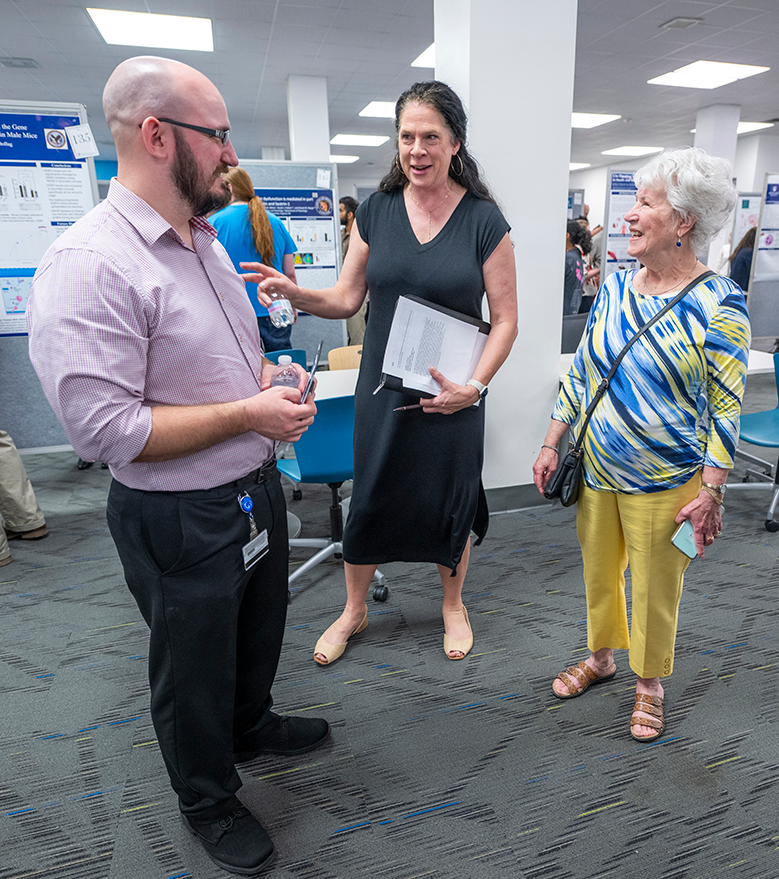
“He loved his students and stayed in touch with many of them and also his colleagues,” Abney explained. “His students loved him because they said he made learning science fun. One of the things that he remembered and enjoyed sharing was that he had good students. He told me everyone would always say, ‘If you heard the laughter down the hall, it was probably Dr. Abney’s lab.’”
“The equipment has changed in the lab, compared to what Tom had in his career. I think it’s just moving so rapidly that I look forward to seeing what science will offer to the next generation,” she marveled.
This year’s keynote speaker was David Glass, MD. Glass is a vice president of research at Regeneron Pharmaceuticals, where he leads the aging and age-associated disorders group and directs the postdoctoral fellow program. He also serves as a senior lecturer at Harvard Medical School and an adjunct professor at Columbia University.
A research day awards luncheon is planned for late April at the Douglas Barnard Amphitheater on the Summerville Campus. Winners in several categories will be announced at that time.

 Morgan Hayes
 Tyler Wooten
 Haley Crain