 Augusta University

 Morgan Hayes
For Puja Punukollu, the path to becoming a physician has never been just about medicine. It has always been about impact.
Originally from Virginia, Punukollu came to Augusta University through its Bachelor of Science and Doctor of Medicine program, drawn to both the opportunity and the environment. After growing up near Washington, D.C., she was looking for something different. Augusta offered that balance; a quieter pace, but still full of possibility.
Now a medical student on that BS-MD track, Punukollu is planning to go into family medicine, but her academic path extends well beyond the traditional route. During her time in medical school, she was simultaneously pursuing a Master of Business Administration and completing a Nonprofit Leadership Certificate through the Pamplin College of Arts, Humanities, and Social Sciences. Earlier in her studies, she explored bioethics as well, adding another layer to how she understands care and decision making.

“As we often discuss in the MPA program and the Nonprofit Leadership Certificate courses, the public and nonprofit sector are all around us and there are few if any positions that do not come into contact with public and nonprofit sector,” said Wesley Meares, PhD, who is director of the MPA Program. “With this certificate, Puja will be able not only be a more prepared volunteer and lead on nonprofit boards but also interact with nonprofits and understand how to better connect their services to her patients.”
Since arriving, Punukollu has taken full advantage of every opportunity in front of her. For her, combining medicine, business and nonprofit leadership just makes sense. Medicine does not exist in a vacuum, and she has always been interested in the bigger picture.
“I want to be an excellent physician,” she shared, “but also someone who can lead, advocate and shape systems that impact communities.”
That mindset has pushed her beyond the traditional path. Through coursework and community-based projects, Punukollu has explored how nonprofits operate and how they directly connect to patient care. One of her most meaningful experiences involved working with local organizations like Compass for Hope, seeing firsthand how care extends beyond the clinical setting.

“As Dean of the College of Arts, Humanities, and Social Sciences, I am proud that our Nonprofit Leadership Certificate complements Puja Punukollu’s pursuit of medicine and business,” said Kim Davies, PhD, dean of Pamplin College. “The program equips students with the practical skills and community-centered perspective essential for strengthening partnerships between clinical care and local organizations. Puja’s work with groups like Compass for Hope exemplifies how interdisciplinary training fosters leaders who improve health outcomes beyond the clinic.”
Of course, balancing it all has not been easy. Medical school alone is demanding, and adding business and nonprofit studies into the mix requires a different level of discipline. But for Punukollu, the payoff is worth it. It has given her the tools to think more strategically, ask better questions and understand the “why” behind the systems she works within.

After graduation, she plans to step into a career in family medicine with long-term goals of leadership in healthcare. Whether that means administration, policy or nonprofit partnerships, one thing is clear: Punukollu is not just preparing to work in the system. She is preparing to help change it.


 Jaylon Brooks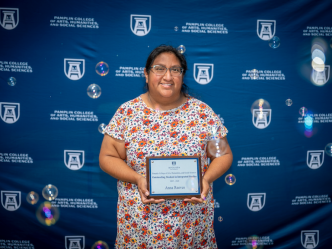

 Tyler Wooten
 Haley Crain