 Augusta University

 Denise Parrish
For nearly four decades, Marc Powers stood in operating rooms across the country, helping surgeons understand and use new medical technology.
As a longtime Stryker representative and sales leader, he built relationships with physicians, observed procedures and spent a career helping innovation reach the people who needed it most. Powers watched equipment evolve from corded systems to battery-powered tools and saw clunky devices become smaller, more precise and increasingly capable of improving patients’ lives.
What he didn’t expect is that one day he would be the patient in need.
Powers retired at age 66 after 38 years with Stryker and settled into the life he and his wife, Katharine Campbell Powers, had envisioned: caring for more than 125 acres in Aiken County, maintaining a longleaf pine forest, tending gardens and enjoying the rhythm of retirement.
Then, in his early 70s, Parkinson’s disease entered the picture. At first, it was the tremor in his right hand – his dominant hand. Eventually, it became constant.
“I knew I didn’t want to walk around trembling in my right hand forever,” Powers said.
The tremor affected more than his comfort. Simple tasks became frustrating. Drinking water, eating soup, brushing his teeth, and holding a microphone or writing down call signs for his recent amateur radio hobby all required a steady hand. Even letting his arm relax was difficult.
“Before, when I was having the tremors, if I wanted to let it rest, I couldn’t,” he said. “It wouldn’t just rest.”
His internal medicine physician in Aiken referred him to Colin McLeod, MD, an assistant professor of Neurology at the Medical College of Georgia at Augusta University and a neurologist with Wellstar MCG Health Medical Center. McLeod recommended deep brain stimulation (DBS), and introduced Powers to Fernando Vale, MD, a neurosurgeon at Wellstar MCG Health and Marshall B. Allen, Jr., MD Distinguished Chair of the Department of Neurosurgery at MCG, who performed the procedure.
Unlike many patients, Powers wasn’t intimidated by the prospect of brain surgery. After spending more than 30 years at Stryker working alongside doctors and introducing innovative tools into a variety of surgical settings, he was already familiar with DBS and understood both the implant procedure and the technology behind it. Since medication was no longer providing the relief he needed, he was ready to move forward.
During DBS surgery, surgeons place thin wires through a small opening in the skull into specific areas of the brain. The wires connect to a small device implanted beneath the skin near the collarbone that delivers carefully controlled electrical impulses to help reduce tremor, stiffness and slowness, while also easing certain medication-related challenges.
Powers was pleased to discover that MCG and Wellstar MCG Health collaborate to provide a Parkinson’s Foundation designated Center of Excellence. Although he was familiar with Augusta, he hadn’t realized the program was considered among the nation’s best until a friend of the family endorsed it.
“They said, ‘Look, if you’re in that program in Augusta, that’s one of the best in the country. You might as well just stay there.’” Powers recalled. “The staff at MCG said I was on the fast track – but it couldn’t have been fast enough for me.”
Powers had his surgical procedures in November 2021 and the improvement has been dramatic.

During the interview, he demonstrated the device by turning it off using a handheld remote. Almost immediately, his right hand and arm began shaking uncontrollably. He then turned it back on. After a brief shock, his hand gradually relaxed and came to rest on the table.
The device does not erase Parkinson’s disease, but it takes away some of its symptoms. In addition, Powers exercises regularly through a Parkinson’s-specific fitness program, and he is intentional about staying active.
But the tremor that once dominated his right hand no longer dictates his days.
He can garden again, growing okra, peas, tomatoes, berries and more. He can operate the equipment – like his Kubota tractor – to manage his property. He can use his ham radio gear. He can enjoy the retirement he had imagined.
“They gave me my retirement and good health as far as I’m concerned. It changed my life,” said Powers, speaking highly of McLeod and Vale and the program.
That statement carries extra weight coming from someone who spent so many years watching healthcare advance from the professional side.
Powers also recognizes that breakthroughs like DBS don’t happen overnight. They come from years of research, patient care, testing and investment.
Both his gratitude and perspective inspired the decision he and Katharine made to establish the Marc B. Powers Movement Disorders Fund for Patient Education & Support, Research & Training, through the Medical College of Georgia Foundation. The couple’s goal was not simply to recognize the care Powers received but to help other patients and families navigate Parkinson’s disease and support the ongoing work that leads to better treatments.
“We just felt that educating people, giving people the ability to learn more about this disease, is important and can help patients, because there are people that have a lot worse side effects from the disease than me,” Powers said.
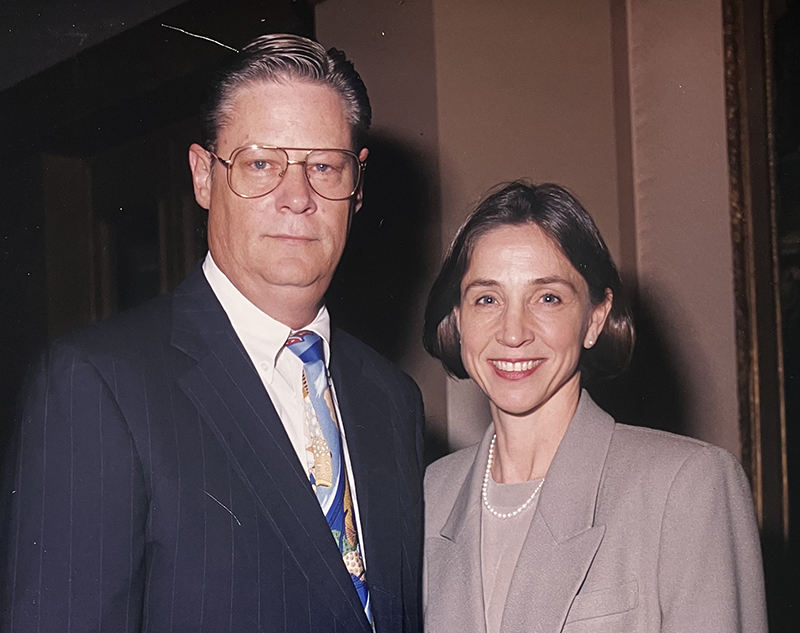
“More outreach could mean catching Parkinson’s much earlier in others, addressing their symptoms sooner, and improving their quality of life earlier and at a younger age than Marc,” Katharine Campbell Powers added. “Also, some of the aspects of the (DBS) procedure are tolerated better by younger patients.”
Powers is especially interested in making practical support more accessible. He believes exercise should be an active part of Parkinson’s care, not just a suggestion handed to patients on a sheet of paper.
“Train like an athlete, not a patient,” he was advised by his Parkinson’s Coach, Gaia Forlani, a neuroscientist, and it has stuck with him.
You can see this philosophy reflected in the way he has approached retirement: staying busy, working outdoors, caring for the land and continuing to learn new things. He earned his ham radio license after being diagnosed with PD because he wanted to challenge himself while he could.
“With this Parkinson’s, you never can tell when the brain’s going to go,” he said. “I wanted to do it quickly and get it done.”
At age 77, Powers describes himself simply as “a hard-working guy.” That description fits the man who spent decades helping medical professionals adopt new technology. But it also fits the patient who has chosen to keep moving, keep learning and keep investing in the future.

 Jamison Guice
 Miguelangelo Hernandez
 Jennifer Hilliard Scott
 Felicia Baskett