 Augusta University
 Tim Rausch
For decades, the medical explanation for fecal incontinence started with the muscle.
A childbirth injury. A tear during surgery. A weakened muscle that controls the bowels that no longer closes with the same strength or timing. For patients, the condition can mean urgency, stool leakage, embarrassment and a daily routine shaped by fear and access to a bathroom.
Satish S.C. Rao, MD, PhD, professor of medicine at the Medical College of Georgia at Augusta University, spent years looking beyond muscle injury into the role nerves might play.
“One area that has been neglected or not studied has been the neurological function and neurological impairment potentially causing fecal incontinence, largely because of lack of access and technology,” Rao said. “It is very hard to do a nerve conduction test inside the rectum because the nerves are starting from the spinal cord in the back. They’re deep inside. You can’t get access to these nerves from outside.”
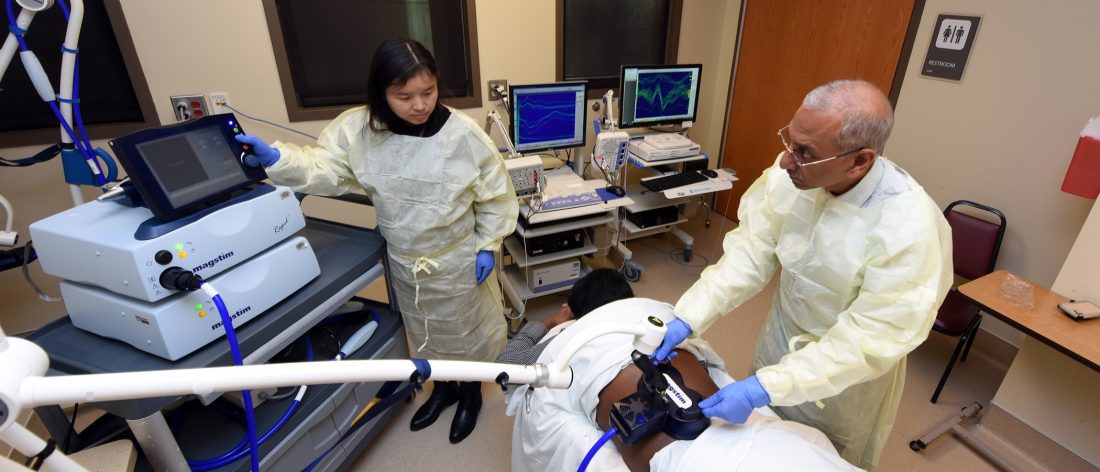
That problem and a potential solution shaped a multicenter clinical trial of translumbosacral neuromodulation therapy, or TNT, a noninvasive outpatient treatment that uses magnetic stimulation to target nerves in the lower back and sacral region that help control bowel function.
The TNT trial, which was sponsored by the National Institutes of Health R01 grant and recently accepted for publication in Gastroenterology, included 109 patients and was conducted by researchers in Augusta and Massachusetts General Hospital, with collaboration from the University of Manchester in the United Kingdom.
The study addresses a condition that is common but often underreported. A global analysis cited in the paper estimates fecal incontinence affects about 8% of adults living outside institutional care, with higher burden among women, older adults and nursing home residents.
Current treatment options include diet changes, fiber, antidiarrheal medication, pelvic floor exercises, biofeedback, injections, surgery and implanted sacral nerve stimulation devices. Those approaches can help some patients, but the authors note that fecal incontinence still lacks effective, condition-modifying, noninvasive treatments.
Looking beyond muscle injury
Rao’s trial focused on the nerve pathways that connect the lower spine, sacrum, rectum and muscles that control the bowels.
A ring-shaped muscle at the end of the bowel helps maintain control over stool. Childbirth injuries, anal surgery and other trauma can damage that muscle, and repairing or strengthening it has long been central to treatment.
But continence is not controlled by muscle alone. The body must sense stool in the rectum, send signals through nerves to the spinal cord and coordinate the muscles that hold it in or allow it to pass. When those signals are delayed or disrupted, leakage can occur even when muscle injury is not the only factor.
The challenge has been measuring those nerve signals.
Rao compares the problem to diagnosing carpal tunnel syndrome, where physicians can test how long it takes an electrical signal to travel through a nerve in the wrist.
But with this condition, testing is more difficult because you can’t get access to these nerves from outside, Rao said.
That’s where the magnets come in. First, his team developed a way to use magnetic stimulation as a diagnostic tool. Secondly, adapting the established concept of repetitive magnetic stimulation from brain-based therapies.
Rao’s team developed a method called translumbosacral anorectal magnetic stimulation, or TAMS, to study those nerves without needles. A small probe with electrodes is placed in the rectum, while an external magnetic coil is applied to four areas of the lower back and sacrum. The system measures how quickly nerve signals travel to the rectal and anal muscles.
“Using that kind of technique, we were able to completely study nerve conduction in a noninvasive way,” Rao said. “So when we started doing this, we were surprised to see that 70% to 80% of patients with fecal incontinence were having neuropathy or nerve damage.”
That finding led to the next research question: If nerve damage is common in fecal incontinence, could nerve dysfunction be improved?
Testing magnetic stimulation as treatment
In the trial, 109 patients were assigned to one of three groups: two receiving different levels of active magnetic stimulations and one receiving sham treatment with a coil that looked and sounded similar but delivered minimal magnetic energy.
Among patients who received the lower number of magnetic pulses, 65.8% met a benchmark of halving the number of incontinent episodes. For the higher pulse group, the results were better, 81.1% of them saw significant reduction in incontinent episodes.
“Most importantly, our target was can we change neuropathy, because that was where we started from,” Rao said. “I mean, because we think this is a neuropathic illness and we are applying a treatment that is supposed to work on the nerve function. Are we changing it? We saw dramatic improvement in the nerve function.”
The study has limitations. The published trial measured outcomes after six weeks of treatment, so it does not establish how long benefits last.
Rao said the next phase is to determine which patients are most likely to have a durable response and which might need continued treatment. In follow-up work presented recently at a national meeting, his team found that many patients maintained improvement after the initial six-week treatment course, while others appeared to gain additional benefit from monthly reinforcement treatments.
The next step, Rao said, is to analyze whether factors such as age, sex, cause of incontinence, severity of nerve damage or sphincter injury can help predict who needs short-term therapy alone and who might need longer-term maintenance.
Aldo Torsoli Foundation Research Award
The research comes as Rao has received international recognition for his work in neurogastroenterology and disorders involving the gut-brain connection.
Rao was named the 2026 recipient of the Aldo Torsoli Foundation Research Award, a joint honor from the Rome Foundation and the Fondazione Aldo Torsoli recognizing research, education and patient care in disorders of gut-brain interaction. The award is presented to mid- or senior-level physicians or researchers with an established record in the field and includes a $10,000 prize.
Rao is a federally funded investigator, has received national and international awards and is a past president of the American Neurogastroenterology and Motility Society.

 Aaron Smith
 Stacey Hudson
 Milledge Austin
 Felicia Baskett