 Augusta University
 Milledge Austin
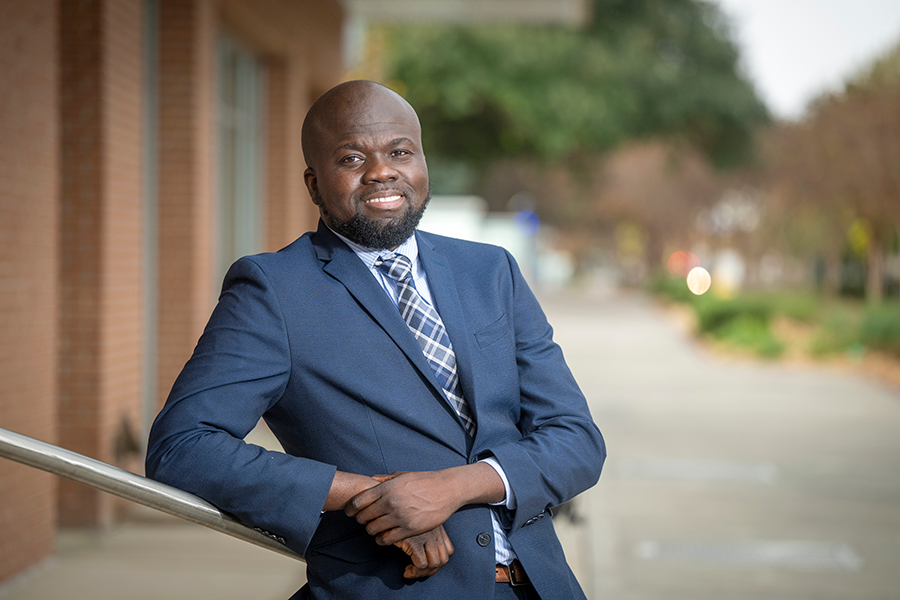
Obed Koomson, PhD, is used to making significant moves to pursue the best opportunities to advance his career, but his most recent move of joining the Georgia Cancer Center as a biostatistician – while covering less physical distance – is probably one of his biggest.
Originally from Ghana, West Africa, Koomson moved to the United States in 2017 to pursue a master’s degree in mathematical sciences from East Tennessee State University, located in Johnson City, Tennessee.
“After earning my bachelor’s in actuarial science, I knew I wanted to pursue a quantitative field,” said Koomson, who will be hooded during AU’s annual December Graduate Hooding Ceremony. “While at East Tennessee State, I took mostly statistics courses, and that’s where I first saw how statistics could directly impact health outcomes. Biostatistics felt like the way I could be part of delivering quality health outcomes, even though I’m not in the lab finding cures myself.”
He completed his degree requirements in December 2018 and started working with Anant Godbole, PhD, at ETSU’s Center for Excellence in STEM Education. It was while working for Godbole that he was first introduced to the PhD in Biostatistics program at Augusta University. Koomson’s mentor understood AU’s strengths and helped him see the benefits of a PhD program where he ultimately found rigorous training and deep faculty support.
Koomson made the decision to move to Augusta to pursue his PhD in biostatistics, but even the simplicity of staying in the same time zone and moving only a few hours away came with its own unique set of obstacles.
Most notably, Koomson made the move while his wife, Rachel, remained in Johnson City to finish her degree. The move was made more difficult by the fact that the couple, which already had a toddler, Aaliyah, together, were expecting their second child, Isaiah.
“Rachel had to stay in Tennessee to finish school, so I traveled back and forth between states,” Koomson said. “My mom, my sister, my father-in-law and my ‘Tennessee mom’ were very supportive and offered a lot of encouragement during this period.”
The ability to travel back and forth between Augusta and Johnson City was made even more difficult by the fact that Koomson began his PhD program at the height of the COVID-19 pandemic in August 2020.
“Obed joined the PhD Biostatistics program in Fall 2020 and quickly distinguished himself as one of the top students in our program. He took two courses with me — Generalized Linear Models I and II — in which he consistently demonstrated deep analytical thinking and strong mathematical maturity,” said Santu Ghosh, PhD, associate professor in the School of Public Health‘s Department of Biostatistics, Data Science, and Epidemiology and program director of the PhD and Master of Science in Biostatistics programs.
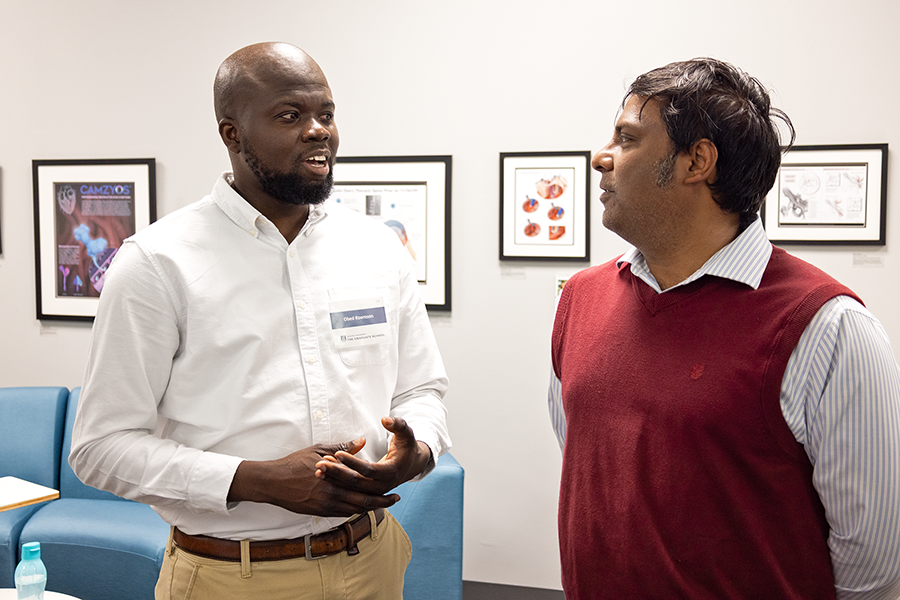
It was the support of faculty from SPH, including Ghosh, Jie Chen, PhD, and Ban Majeed, PhD, that truly helped Koomson overcome what seemed at times like a nearly impossible situation.
“When I opened up to my faculty about my situation, they were incredibly supportive. They allowed me to take certain courses remotely and helped me balance academics and family life. It wasn’t just academic support. The faculty cared about my personal and social well-being,” he said.
What he didn’t know was that compassion and support was a two-way street.
In the fall of 2022, Koomson was working with Majeed on her tobacco research projects when she unexpectedly lost her father and later faced a life-threatening diagnosis. Koomson stepped up to help Majeed in an extremely meaningful way.
“I would like to express my sincere gratitude to Obed. That semester was an extremely challenging time for me as I experienced the loss of my father and later faced a life-threatening diagnosis,” said Majeed, an associate professor in the Department of Biostatistics, Data Science, and Epidemiology. “Throughout this difficult period, Obed was exceptionally kind and dependable. He not only assisted with grading for our large online course of nearly 300 students but also offered encouragement when I needed it most. I still have the ‘Get well soon’ card he gave me in which he said, ‘Keep on flexing your faith muscle.’ His professionalism and compassion made a significant difference. Beyond his expertise in biostatistics, he was always willing to help me with practical – and sometimes random – needs, such as resolving computer or electronic issues.”
While Koomson may not be fond of attention, his hard work and determination, as well as his reliability and strong character. have left a mark on the faculty and his fellow students he has worked alongside, including Chen, SPH’s associate dean for academic and student affairs. Koomson worked with Chen on her research in change-point analysis.
“As a student, Obed is highly capable of pursuing a coherent scientific argument both orally and in writing. He is a student who takes his academic goal seriously,” Chen said. “His dissertation contributes solidly to the literature of statistical change point analysis with modern applications. Obed has excellent theoretical and computing skills, which is a trait that a modern-era biostatistician and data scientist must have. Obed has tremendous potential for making positive contributions to the research at his job.”
Working with Chen afforded Koomson the chance to fine-tune his research processes, as well as refine his presentation skills.
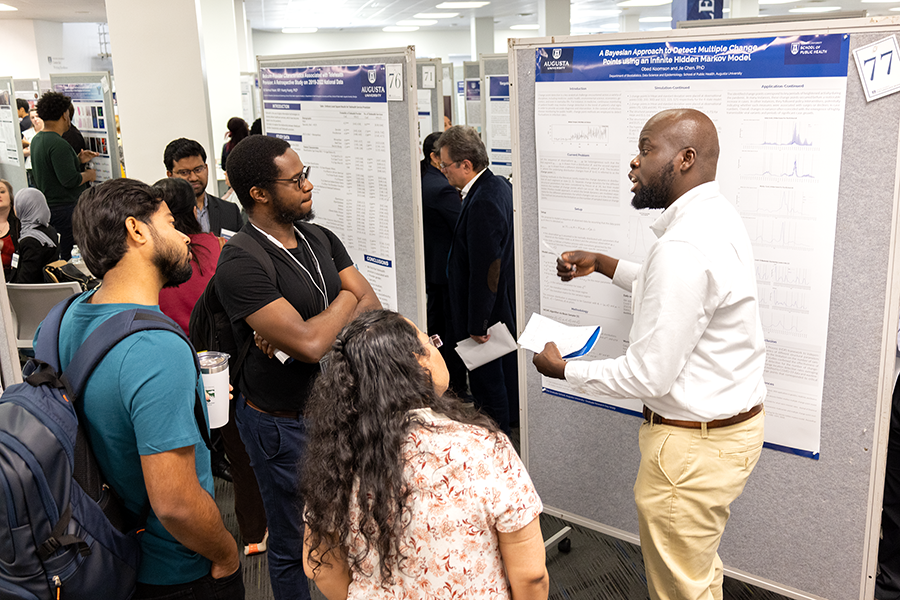
“When I first heard Dr. Chen present her work in change-point analysis, I immediately saw its potential. That’s when I knew I wanted to work with her,” he said. “She spent hours with me one-on-one, guiding me on how to become an excellent researcher. The method we developed is very unique, and presenting it at Graduate Research Day and national conferences was challenging but rewarding.”
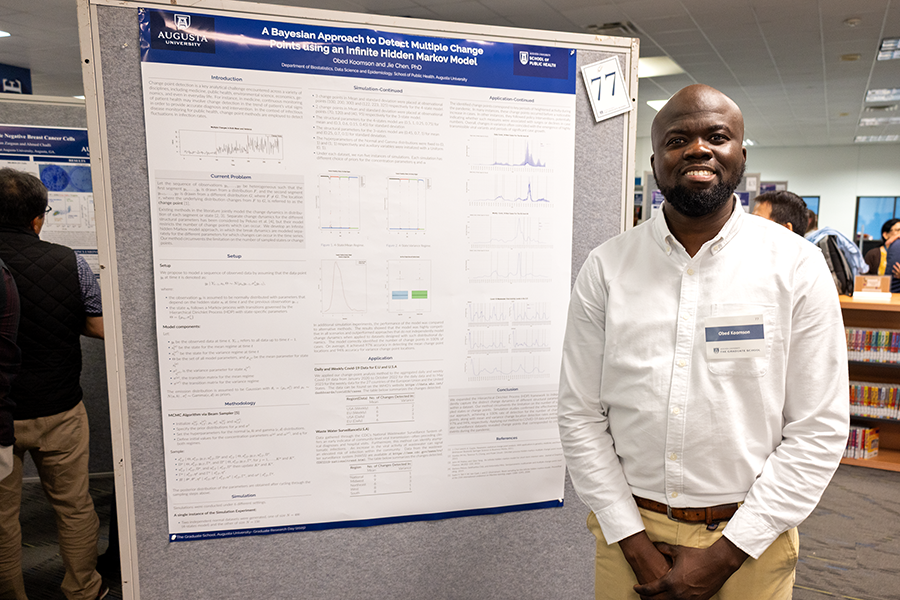
Outside of presenting at AU’s Graduate Research Day earlier this year, Koomson has been afforded opportunities to present his research and gain valuable experience, including at the spring 2025 meeting of the Eastern North American Region International Biometric Society in New Orleans.
“I served as a member of Obed’s dissertation committee, where he completed a nice dissertation on change-point analysis using Dirichlet process priors. His work was rigorous, well-organized and reflected an independent research ability,” Ghosh said. “Beyond his academic strengths, Obed is a humble and thoughtful individual, and I always enjoyed interacting with him. I am very proud that he is a graduate of our PhD Biostatistics program.”
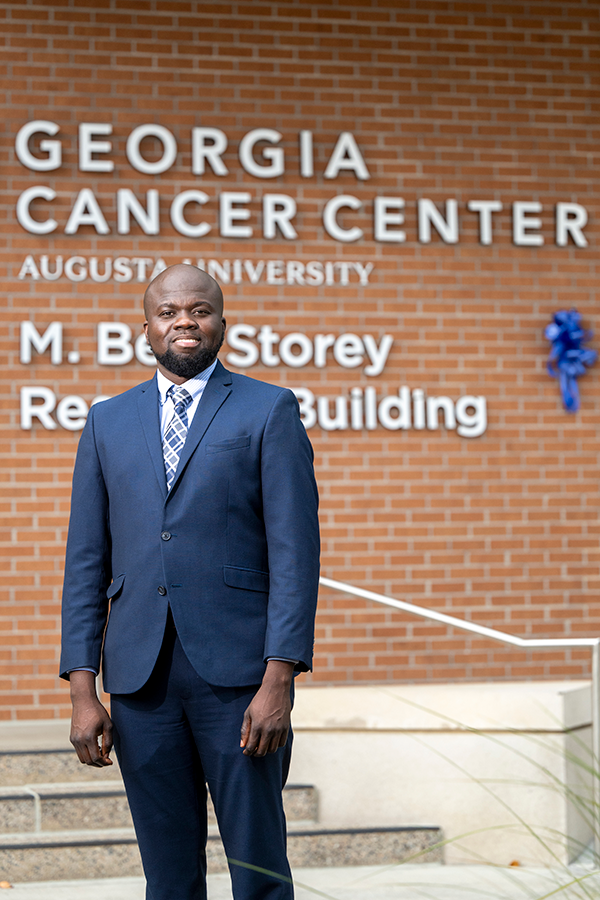
Koomson is currently a biostatistician working with Ramses F. Sadek, PhD, in the Biostatistics Core of the GCC. The Biostatistics Core supports Georgia Cancer Center researchers. The biostatisticians also conduct their own research, using data from the Cancer Center registry, clinical and laboratory sources, Surveillance, Epidemiology, and End Results, or SEER Program, and other national databases for statistical analysis and data mining.
“It felt like it was written in the stars. Now I get to contribute to clinical research right here in Augusta,” he said. “Augusta University has been very helpful to me, academically, socially and personally. If anyone asks me where they’ll find support, I have evidence that AU provides it.”

 Stacey Eidson
 Bakija Parks
 Miguelangelo Hernandez
 Jamison Guice