 Augusta University
 Sidhartha Wakade
Katy Dunstan is far from a traditional undergraduate student, and the Department of Physics and Biophysics will have big shoes to fill after she graduates this December.
Dunstan’s life before coming to Augusta University was already busy. She worked as a licensed esthetician, or a professional who provides cosmetic skincare treatments. She has a 10-year-old son, Thomas Blanton III, to look after while working and maintaining her home. After going through a divorce and reevaluating career choices, however, she decided that a change was necessary.
“I worked in my field for a while and still maintain my license, but it’s not what I wanted to do,” she said.
With support from her son and her husband, Richard, Dunstan decided to enroll as a full-time student in AU’s College of Science and Mathematics, majoring in physics with a concentration in the Nuclear Science Program. Her original plan was to get a construction management engineering degree. Since her husband works in construction and her father had the same degree, she was familiar with the options in that field.
“I do like to build things. I always like to tinker,” she said. “I’ve always been a precise person, and I like things to be exact.”
Her focus on organization and precision turned out to be perfect for building electronics, despite her lack of coding knowledge initially, and it helped her earn recognition by the faculty in the department. Joe Newton, PhD, associate professor of physics and program manager for nuclear science, asked her to consider his program.
“This is all his fault, and I love him for it,” Dunstan said. “I switched to physics and never looked back.”
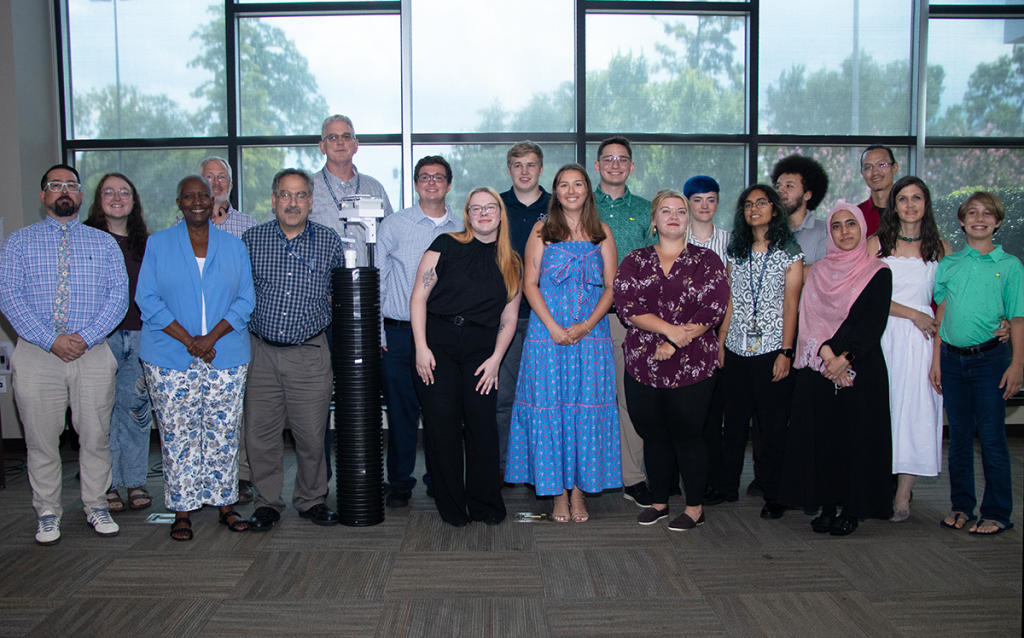
“Katy is such a hardworking and dedicated student who stays motivated by keeping her end goals in mind,” Newton said. “It is also really cool that she is in the cohort of students who will mark the 100th graduate of the Nuclear Science Program, because she embodies the qualities that this program values.”
Her work with electronics was also noticed by Andy Hauger, PhD, professor of physics and head of the Augusta Utilities Internship program. Dunstan’s projects during her Electronics II course impressed him. Near the end of the semester, Hauger suggested she come work for his summer internship program and build a prototype water depth sensor.
“I pay close attention to craftsmanship. It’s very important,” Hauger said. “Katy is persistent, dedicated and her level of craftsmanship is unequaled around here.”
She joined the program to work alongside a team of highly motivated students with the same penchant for building, tinkering and problem-solving, all of which have become staple traits for the Augusta Utilities students. Every student in the program works together with other students, Hauger and representatives from Augusta Utilities to create devices that help the City of Augusta meet its utilities and water monitoring needs.
Dunstan leaves behind an impressive amount of work. Most notable is the sleek, cost-effective water depth sensor she designed as her main project, affectionately referred to as H2-Float. She revised a version of a floating pipe and load cell monitor that had previously been used in a lab and designed it to be used on the Augusta Canal. What once began as a prototype in a classroom has now become a routine tool for Augusta Utilities, often outperforming industry-standard alternatives for a fraction of the price.
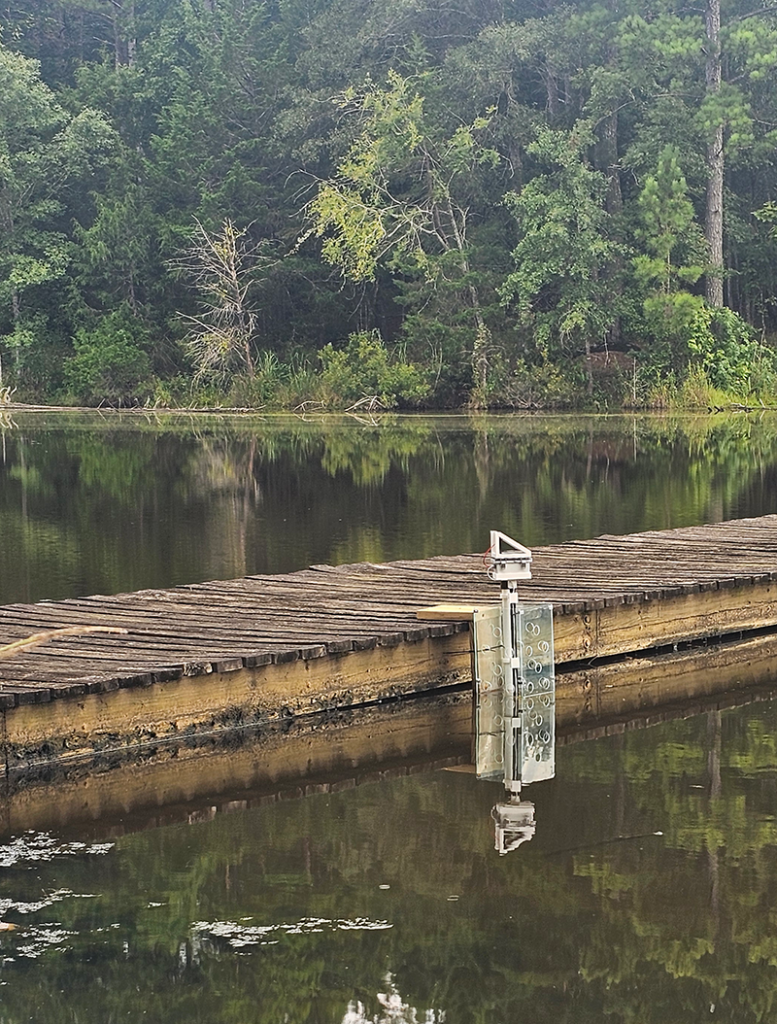
“The other version used expensive monitors that already existed, and they put their load cell on top,” Dunstan said. “In the real world, you have temperature differences which affect how a load cell works. If it gets too hot or cold, the readings change.”
Not only did she fix the load cell problem, but her total cost for a four-foot sensor comes out to around $200, and a six-foot sensor is only slightly more expensive. Similar industry-grade water level sensors cost upwards of $1,500, with extra costs for additional features such as Bluetooth connections and data storage.
Dunstan’s sensors are programmable through Arduino and Particle microcontrollers, allowing all of her designs to be open-source and available for anyone to use and modify based on their own research criteria. They can connect to cell towers to transmit their data or work through LoRa, which is long-range radio. Unlike the commercial sensors, no one needs to stand next to the H2-Float sensors to record data or make sure the device remains undamaged, since the device transmits the data and is easily repairable or replaceable.
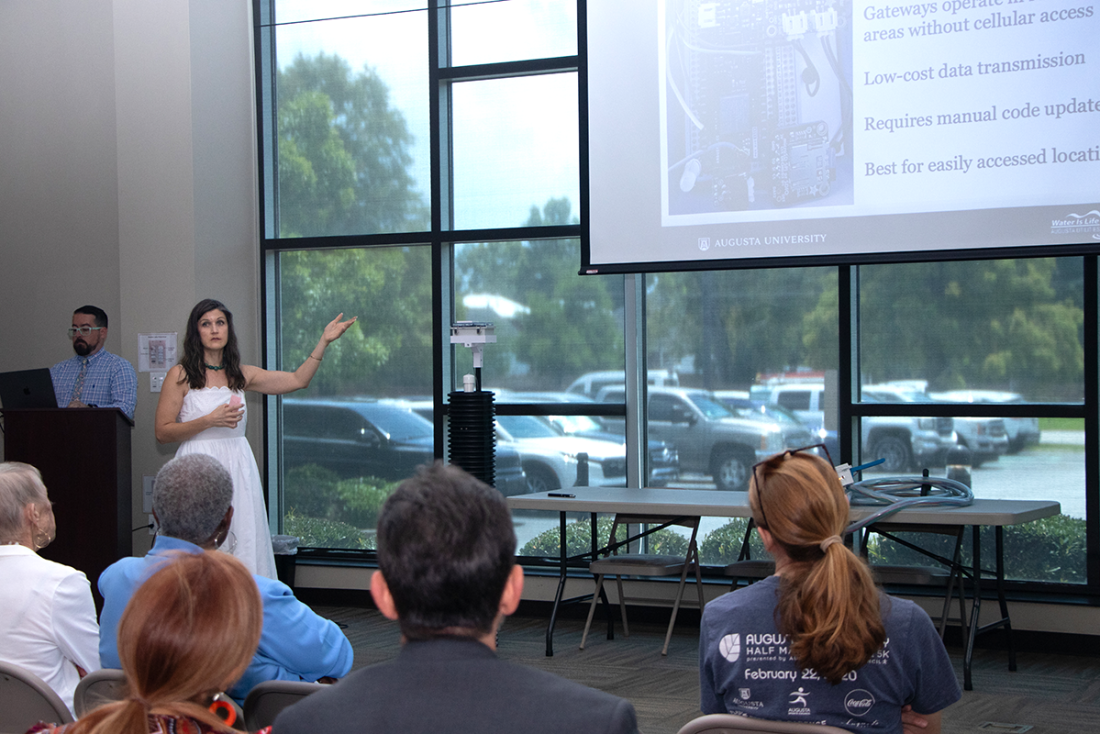
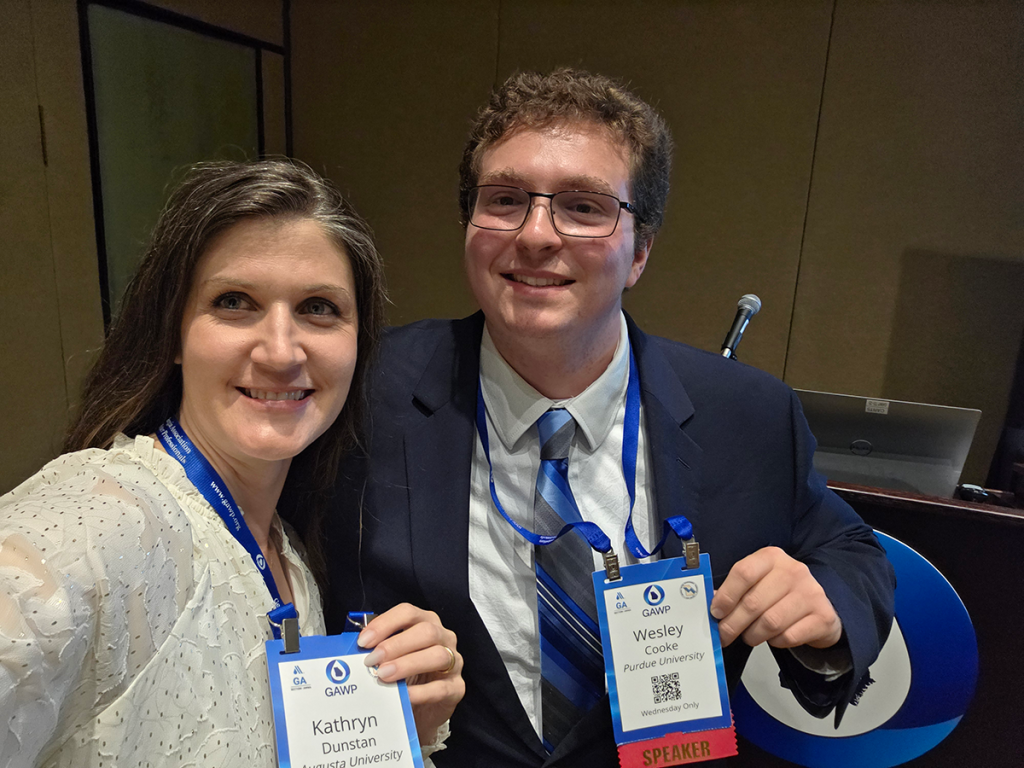
Dunstan presented her device during the 2025 Georgia Association of Water Professionals Annual Conference and Expo in November 2025, along with several other Augusta Utilities students. She continues to test the H2-Float and build more of them for the city until her graduation, and the utilities department has already requested four to be put on the canal. She hopes to see this sensor used to monitor various types of water conditions going forward, especially when dealing with flood conditions.
“Ultimately, I would like this to be utilized to mitigate dangerous water conditions,” she said. “Since this device is easily made, inexpensive and can extend to whatever size you need, I would like to see it put out in 20 to 30 water sources in the area. Augusta Utilities can use the data from these sensors to improve models used to predict flooding and drought conditions.”


 Chris Curry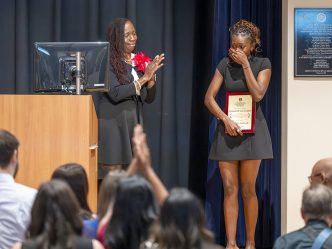
 Miguelangelo Hernandez
 Stacey Eidson