 Augusta University


 Milledge Austin
A team of researchers with the Immunology Center of Georgia, which is part of the Medical College of Georgia at Augusta University, has identified a specific set of immune targets that may help explain how the immune system contributes to atherosclerosis, a chronic artery disease responsible for most heart attacks and strokes.
The study, “Increased Autoreactive CD8+ T Cells to Apolipoprotein B Epitopes in Patients With Severe Coronary Artery Disease,” was recently published in Circulation Research, a journal published by the American Heart Association. The team led by Klaus Ley, MD, and Hossam Abdelsamed, PhD, focused on apolipoprotein B (ApoB), a protein found in LDL cholesterol particles that has previously been implicated as an autoimmune target in cardiovascular disease.
“We previously looked at the CD4+ T cell responses to ApoB. In this study, we identified five immunodominant epitopes that drive the CD8+ T cell response to ApoB,” said Ley, founding co-director of the Immunology Center of Georgia, Georgia Research Alliance Bradley Turner Eminent Scholar Chair in Immunology and professor of physiology. “Epitopes are short peptides within the protein sequence to which T cells respond by proliferating and making inflammatory cytokines, molecules that can worsen atherosclerosis.”
First authors on the paper include Payel Roy, PhD, formerly a postdoctoral fellow and assistant research assistant in Ley’s lab before becoming an assistant professor in the Department of Biochemistry at the Indian Institute of Science, Bengaluru, India, as well as Smriti Parashar, PhD, a postdoctoral fellow in the Ley Lab.

“Our study focuses on a special killer immune cell subset, the CD8+ T cells, that normally protects us from infectious diseases and cancer. However, when their killing activity is wrongly misdirected towards our body’s own proteins, they can cause massive tissue damage that are difficult to heal. This is well-established for many classical autoimmune diseases such as Type 1 Diabetes where the target proteins have been elucidated in detail,” Roy said. “Our study moves the field forward by identifying which sequences in a host protein cause CD8+ T cell mediated aberrant autoreactivity in cardiovascular diseases (CVD). This enabled us to track these CVD-related CD8+ T cells in human blood.”
The team also included Megh Mehta, a graduate research assistant in the Ley Lab and PhD candidate in AU’s Molecular Oncology and Immunology PhD program; Yan Wang, PhD, a postdoctoral fellow in the Ley Lab; Ishita Tandon, PhD, a postdoctoral fellow in the Abdelsamed Lab; and Irina Baranovskaya, PhD, a postdoctoral fellow of the Hedrick Lab.

“I am very happy to have contributed to this seminal work, which could help assess coronary artery disease risk via a simple blood test that detects self-reactive T cells,” Parashar said. “Dr. Ley and Dr. Roy have spearheaded this field for many years and I am looking forward to see where this work takes us next.”
Previous research demonstrated that immune cells can recognize ApoB, but little is known about how CD8+ T cells, one of the most abundant immune cell types found in atherosclerotic plaques, respond to the protein.
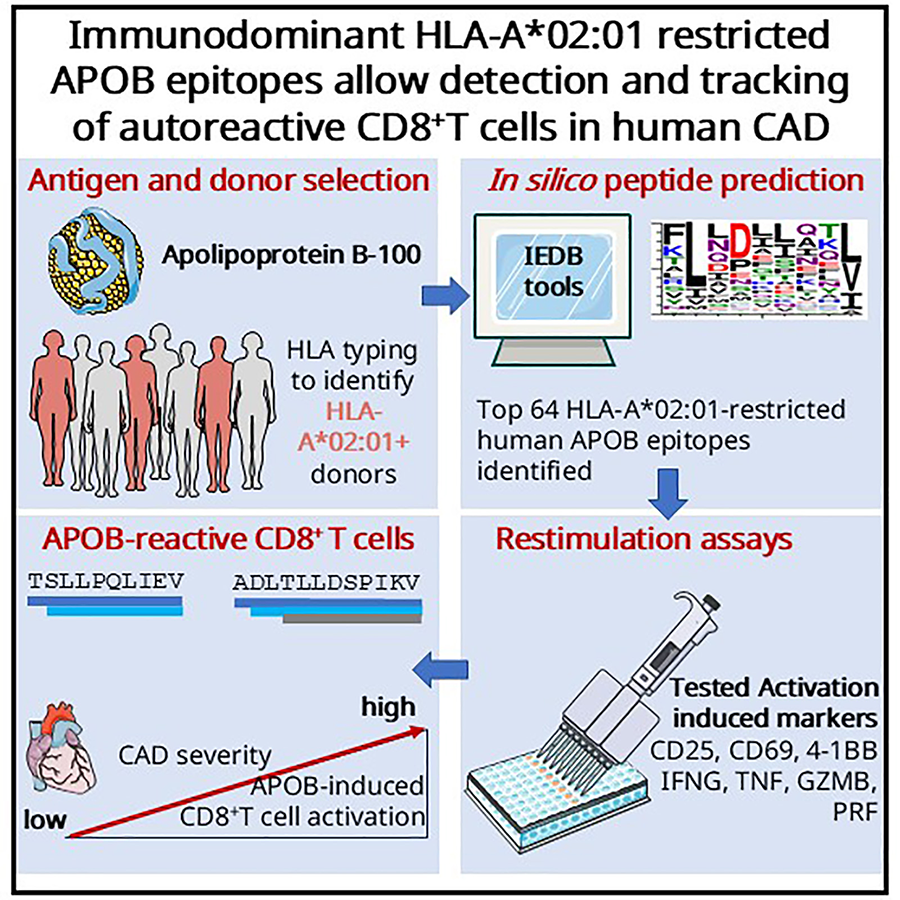
Using computational analysis and immune testing of human blood samples provided by MCG’s Section of Vascular and Endovascular Surgery and the University of Virginia, the team screened approximately 4,600 ApoB-derived peptides predicted to interact with HLA-A*02:01, one of the most common human immune presentation molecules. This led to the researchers being able to identify five immunodominant ApoB epitopes that generated the strongest CD8+ T-cell responses.
The study found that ApoB-specific CD8+ T cells were present even in healthy individuals; however, responses were significantly stronger among patients with severe coronary artery disease.
According to the researcher team, these cells displayed characteristics associated with activated effector memory T cells and produced inflammatory cytokines and cytotoxic molecules, indicating they may be capable of contributing to vascular inflammation.
Importantly, the five identified epitopes accounted for approximately half of detectable ApoB-specific CD8+ T-cell responses in human blood, suggesting that immune recognition may be concentrated around a relatively small number of ApoB peptide sequences.
The findings provide researchers with new tools for tracking and studying autoreactive CD8+ T cells in cardiovascular disease leading to the development of antigen-specific immunotherapies designed to modulate harmful immune responses without broadly suppressing immunity.
“What is remarkable is our observation that these defaulters are already present in normal people without any known condition of heart disease. By measuring their activity in patients with clinically diagnosed coronary artery disease, we were able to demonstrate that their numbers and activation potential increase under diseased conditions, highlighting their role in the pathogenesis of human CVD,” Roy said. “In the future, we plan to employ cutting-edge technologies to discover the molecular ‘fingerprints’ of these pathogenic cell-types. These will form the cornerstones of precision medicine for cardiovascular disease.”


 Jennifer Hilliard Scott

 Aaron Smith

 Paige Tucker

 Valerie Emerick