 Augusta University
 Milledge Austin
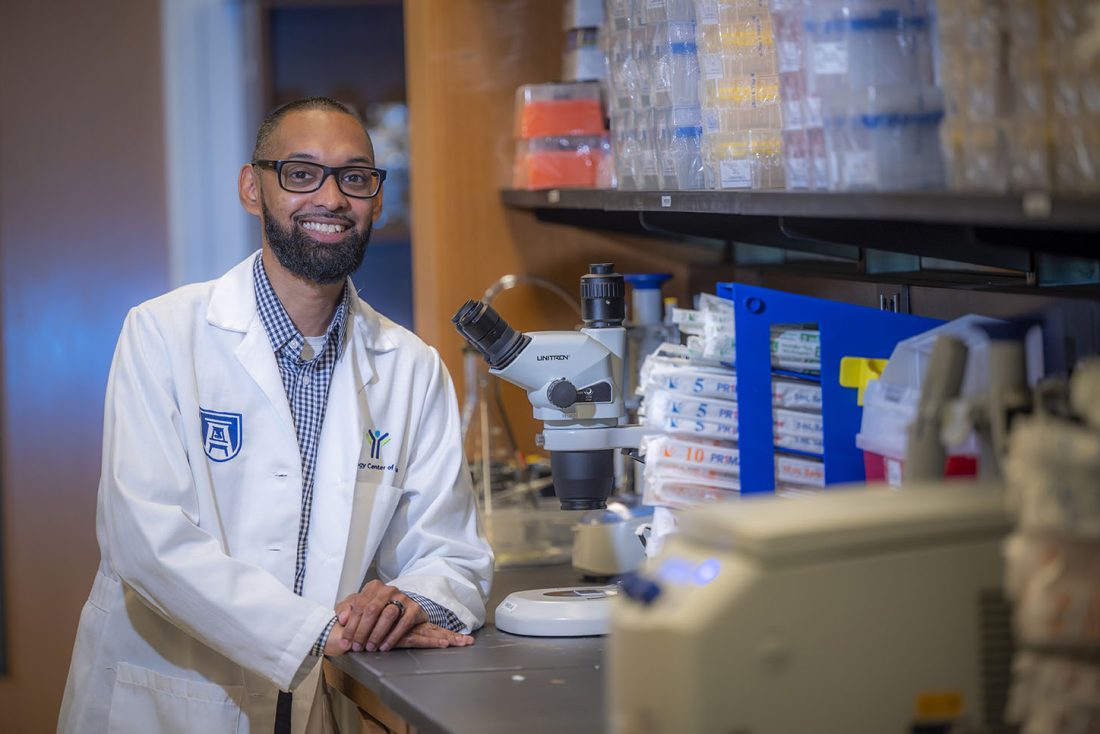
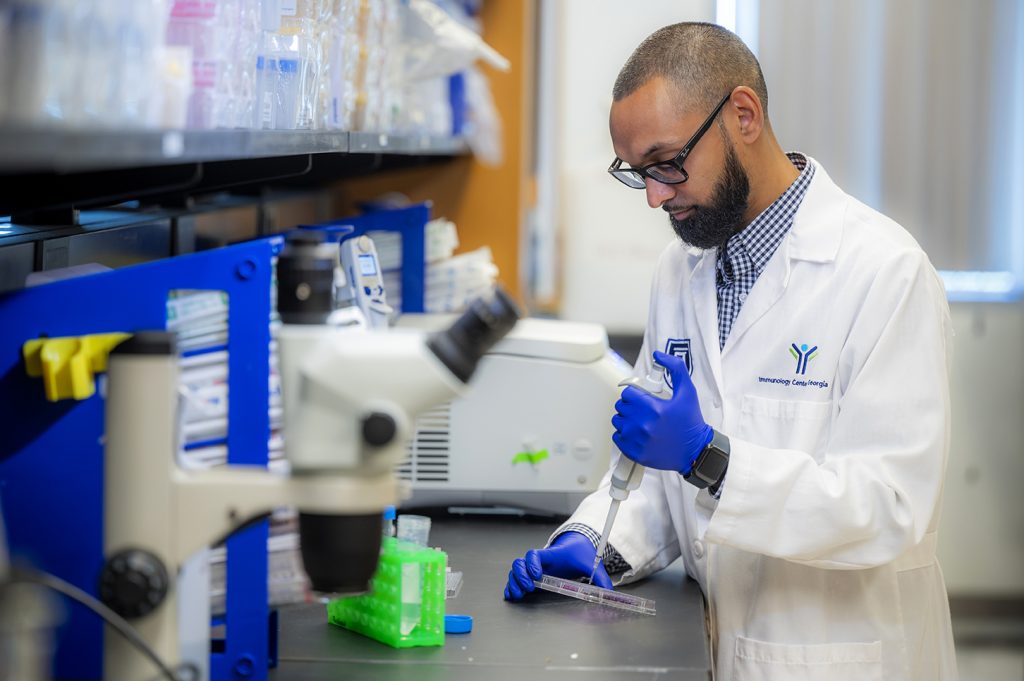
Adil Rasheed, PhD, an assistant professor and researcher with the Immunology Center of Georgia in the Medical College of Georgia at Augusta University, has been recognized with the Biomedicines Young Investigator Award.
The award, established in 2020, is designed to recognize early-career researchers in the field of biomedicines who have earned their PhD/MD within the past 10 years, produced ground-breaking research and made a significant contribution to the advancement of biomedicines.
“This was a really interesting opportunity because it forced me to reflect on everything I’ve done to this point in my career,” Rasheed said. “It is rewarding to see how these individual pieces of work throughout my career fit into research themes, and it helped me put the ongoing work in my lab into perspective.”
Rasheed joined IMMCG in November of 2023, and his lab’s research is focused on the intersection of lipid metabolism with immune cell fate and function in atherosclerotic cardiovascular disease.
“Dr. Rasheed is our resident specialist in macrophages, lipids and extramedullary hematopoiesis, a process where blood cells are made outside their normal production sites,” said Klaus Ley, MD, co-director of the Immunology Center of Georgia, Georgia Research Alliance Eminent Scholar and professor of physiology. “His work is unique in merging these three fields, all relevant to cardiovascular disease.”
Atherosclerotic plaque builds up over several decades as excess lipids, and immune cells accumulate in the heart. Macrophages, a type of immune cell, engulf these lipids to protect the heart. However, as lipid buildup continues, this process becomes harmful, leading to formation of foam cells that are typical of atherosclerotic plaques, inflammation and eventually, fatal complications like heart attacks.
Rasheed’s research found that a type of cell death called necroptosis plays a role in the development of the necrotic core, making atherosclerotic plaques prone to rupture. The mixed lineage kinase domain-like protein, also known as MLKL, was first identified in 2012 as a key regulator of necroptosis. However, Rasheed’s work showed that, early on, MLKL actually helps limit foam cell accumulation by promoting lipid breakdown in macrophages.
However, not all foam cells are the same, and they can come not only from macrophages but also from smooth muscle cells, known as SMCs. Although these SMC foam cells resemble macrophages, they are lacking in certain processes. Rasheed and colleagues found that SMC foam cells struggle to remove excess lipids through autophagy, unlike macrophages, but treatment with metformin can help.
Immune cells that gather in atherosclerotic plaques are produced through a process called hematopoiesis, where stem cells mature into immune cells. This usually happens in the bone marrow, but during inflammation, the spleen can also produce immune cells. By studying MLKL, Rasheed’s work revealed that the spleen’s environment is more susceptible to excess lipids than the bone marrow.
Rasheed’s current research focuses on interventional approaches for cardiovascular disease and how to leverage the existing dysfunction to perhaps halt the progression of disease or push it back. His lab currently has several research areas associated with cardiovascular disease:
- how to stop macrophage foam cells from actively triggering of heart attacks and strokes that can result in death;
- how organs beyond the heart and blood vessels, such as spleen and bone marrow, can worsen or protect against cardiovascular disease;
- learning to harness the liver’s role in immune metabolism and leveraging that for therapy and cardiovascular disease and cancer.
“Early on in my PhD program, I was lucky enough to work in an endocrinology lab where we were focused on leveraging nuclear receptors, which are ligand-activated transcription factors, to treat metabolic diseases,” Rasheed said. “My PhD is in pharmaceutical sciences, and that really helped me think about the different therapeutic strategies we use to treat patients, such as tissue-specific targeting of drugs or genetic therapy.
“One great thing about my training as a postdoctoral fellow at the Ottawa Heart Institute is that it really helped conduct impactful basic science studies, while emphasizing the need to think about the translational aspects of the work,” he continued. “Receiving this award is not only a great honor for me personally, but also reaffirms all the training I have had throughout my career and is a testament to the training I have had and continue to receive from all of my mentors.”


 Stephanie Hill
 Felicia Baskett
 Jennifer Hilliard Scott
 Hannah Litteer