 Augusta University
 Stacey Hudson
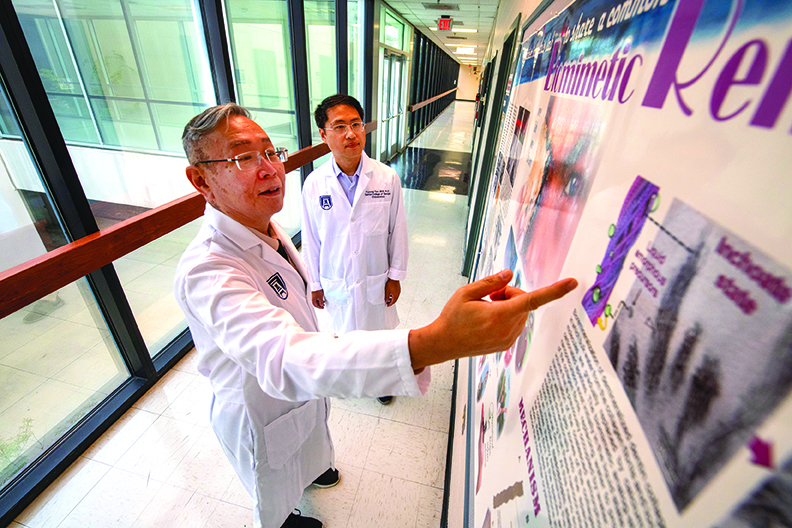
Scientists at the Dental College of Georgia at Augusta University are working to help dentists improve healing and regeneration in older patients by encouraging aging cells to function more like younger ones.
The research focuses on a technique called partial cellular reprogramming. The goal is to help aging tissues repair themselves more effectively, and the review article, “The epigenetic rejuvenation promise: Partial reprogramming as a therapeutic strategy for aging and disease,” is published in the March issue of the journal Ageing Research Reviews.
“Many common dental problems become harder to manage with age because the mouth’s repair ability slows down,” said Franklin Tay, PhD, professor and chair of the Department of Endodontics at DCG and one of the study’s authors. “The dental pulp becomes less responsive, gums heal more slowly and bone around teeth and implants may regenerate less effectively.”
As people age, procedures such as periodontal therapy, implant placement, deep restorations and vital pulp treatments often require longer healing times and can produce less predictable results. Tay and his colleagues are studying whether partial reprogramming can safely refresh aging cells and restore some of that lost repair capacity.
“Dr. Tay’s work brings scientific depth and strategic clarity to one of the most transformative frontiers in regenerative biology. By defining how epigenetic rejuvenation can be advanced with precision and safety, this work helps move the field from conceptual promise toward real therapeutic potential,” said Babak Baban, PhD, professor and associate dean for Research at DCG.
The approach stems from growing evidence that aging involves more than wear and tear.
“Your DNA is like a fixed instruction book,” Tay said. “But your cells also rely on a separate set of notes and bookmarks that tell them which instructions to use and when. As we get older, those notes can become messy or misplaced.”
Scientists call those notes “epigenetic signals,” which help regulate how cells function. Partial reprogramming aims to reorganize those signals, so cells behave more like they did when they were younger without changing the DNA itself.
“The goal is to refresh a cell’s settings without wiping its identity,” Tay said. “In simple terms, the cell gets a tune-up, not a complete reset.”
The concept builds on Nobel Prize-winning research by Shinya Yamanaka, who identified four factors, now known as Yamanaka factors, that can reset mature cells to a more flexible, stem cell-like state. A full reset, however, carries risks.
“If a cell becomes too flexible, it may forget what it is supposed to be and start growing in an uncontrolled way,” Tay said. “That increases the risk of tumors. That is why we focus on partial reprogramming rather than full reprogramming.”
In laboratory and animal studies, researchers have shown that briefly activating these rejuvenation pathways can improve tissue recovery and function in older organs. Those early findings have prompted further study of how the strategy could apply to dentistry.
DCG researchers are also developing safer delivery methods. Instead of inserting genes into cells, scientists are creating mixtures of small, drug-like chemicals that mimic the desired effects. These chemical cocktails are easier to control and stop, which may reduce hazards associated with permanent genetic changes.
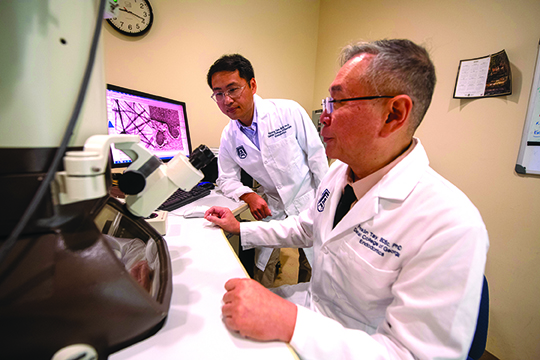
“These approaches may avoid many of the risks associated with viral or long-lasting genetic modification,” Tay said. “They also give us the ability to tailor treatments to specific tissues.”
Dentistry might offer advantages for localized treatment. Dentists already use gels, membranes, scaffolds and slow-release materials that could deliver rejuvenation factors directly to a targeted site.
“Local delivery matters because it could limit effects to the mouth and reduce whole-body risks,” Tay said.
To better understand how aging tissues respond, vision science researchers often leverage the eye’s compartmentalized anatomy, which allows close monitoring of tissue regeneration while limiting systemic exposure. The review discusses retinal and optic-nerve applications and notes that CRISPR-based approaches are being explored to improve the precision, controllability and safety of partial reprogramming.
A first in-human clinical trial sponsored by Life Biosciences is expected to begin in the first quarter of this year.
Tay said the review aligns with the college’s broader mission to serve the public by clarifying where the science stands and what safety questions remain.
“This is a rapidly moving area, and our goal in this review was to synthesize the evidence, highlight promising directions and be clear about the hurdles that still need to be addressed before widespread clinical use,” Tay said. “Augusta University is part of this broader effort in regenerative medicine, and we aim to contribute careful, responsible research while training the next generation of scientists here in the state.”
Research.com lists Tay among the top 100 materials science scientists in the United States and top 200 worldwide for 2025/2026. In 2019, the Journal of Investigative and Clinical Dentistry recognized him as tied for the fourth most productive dental researcher in the world.
Baban said that Tay’s research is among those driving Augusta University’s expansion of its national research profile and NIH competitiveness.
“Scholarship of this vision and rigor positions the Dental College of Georgia at the forefront of next-generation regenerative and aging science.”
Beyond dentistry and vision science, partial reprogramming may support healthier aging across multiple organ systems, including the brain and heart. Researchers are exploring how epigenetic rejuvenation could work alongside other healthy aging strategies to improve both lifespan and quality of life.
“Aging may not be as fixed as we once believed,” Tay said. “That realization has changed how scientists think about what is possible.”

 Paige Tucker
 Chris Curry
 Miguelangelo Hernandez