 Augusta University
 Hannah Litteer
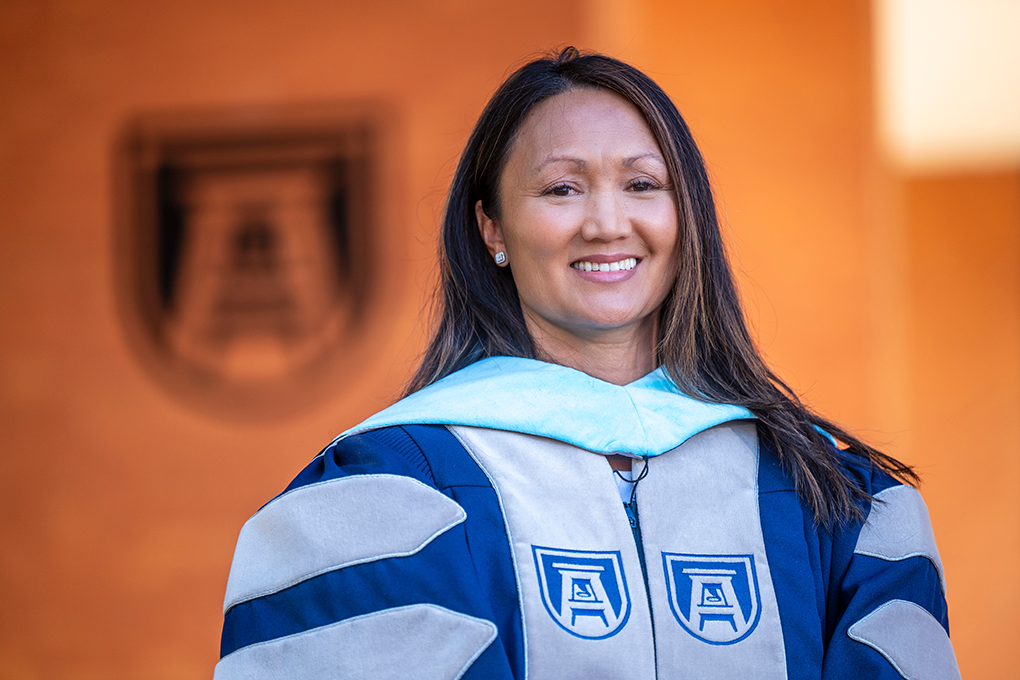
The woman responsible for implementing a new degree program in Augusta University’s College of Allied Health Sciences is making her mark on the institution again with another momentous accomplishment.
After three-and-a-half years of long days and longer nights, countless hours spent studying while holding a full-time faculty position – and navigating a natural disaster that jumbled up everything – Joann Denemark, EdD, the program director of AU’s new Master of Health Science in Speech-Language Pathology degree program, is graduating this month with an EdD in Educational Innovation with a concentration in Leadership from the College of Education and Human Development.
Since joining the university back in 2021, much of Denemark’s time at AU can be summed up with one word: persistence.
“One of my professors described getting your doctorate as an exercise in persistence, and I’ve always remembered that,” she said. “And anytime I ask myself, ‘Why did I do this?’ I remind myself I’m exercising persistence.”
While Denemark originally had no plans of going back to school once she received her master’s degree in 2001, becoming the MHS-SLP program director changed her academic trajectory.
In order to get the program up and running, she had to get approval from the University System of Georgia’s Board of Regents and double accreditation from the Southern Association of Colleges and Schools Commission on Colleges and the Council on Academic Accreditation in Speech-Language Pathology and Audiology.

CAA accreditors require at least 50% of faculty in the program to have a research doctorate, and, to be safe, Denemark took advantage of USG’s Tuition Assistance Program and the EdD program the university offers to make sure that she, as well as all of the faculty working under her, had research doctorates and were well in compliance with accreditation criteria.
But there is another reason that trumps all when it comes to Denemark’s drive to further her education and provide a well-rounded academic and clinical education for future SLPs – and it’s why she got into the profession in the first place.
“I’m an advocate, period. For my profession, for the kids I used to see, for my former patients, and that’s why I’m doing this and why I started this program,” she explained.
“Advocacy for them, not for me, not for AU. There’s a critical shortage of SLPs nationwide, which means there are long waitlists for speech pathology services,” she continued. “One hundred to 150 kids on a waitlist at every facility, just getting further and further behind. If a child is presenting a delay or disorder, a parent wants to do the best they can for them, but they can’t because of these long waitlists. So, that’s really what drives me to move forward and why I stay focused.”
Aside from benefitting patients, students, the program and the university, Denemark earning her EdD has helped her grow in her faculty position and may open more doors for her in the future.
“My concentration in leadership has helped me in my role as a program director,” she said. “And the whole research process of conducting a study, obtaining IRB approval and completing all of the steps for my dissertation and defending it actually helped me with my faculty position because now I understand even more the evidence-based practice behind why we do the things we do.”
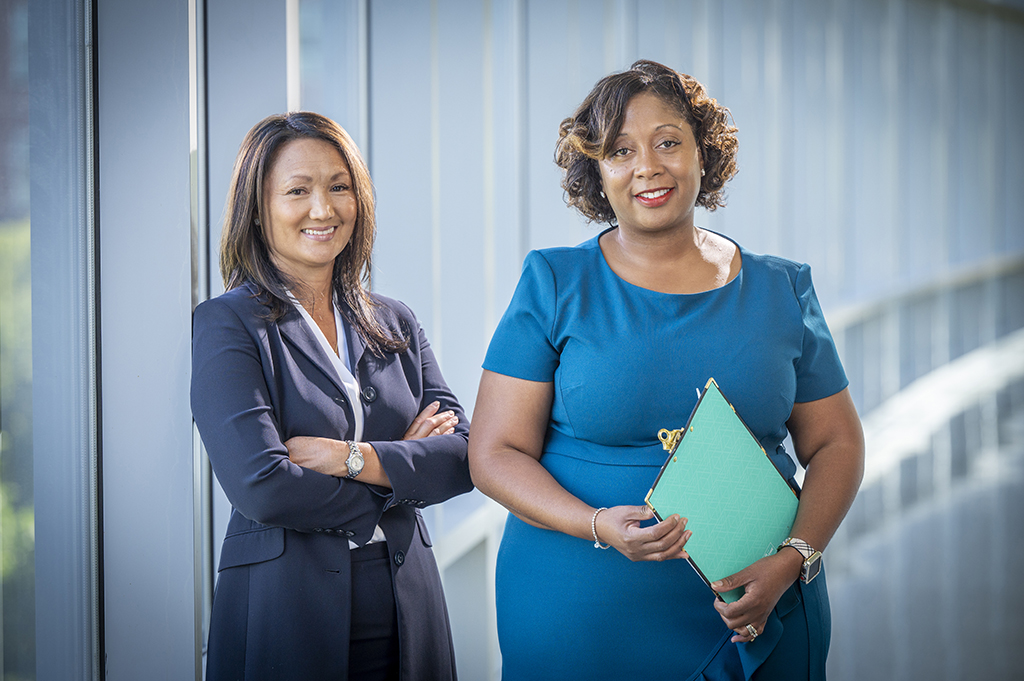
Denemark’s dissertation topic was on interprofessional education, which she described as different health care disciplines coming together to improve patient-centered care.
“You have speech pathologists, physician assistants, occupational therapy and physical therapy coming together to hopefully decrease the amount of times patients have to go to the doctor,” she said. “That’s a really hot topic we’re covering in our preprofessional academic programs – you’re always referring to other healthcare professionals to best meet the needs of the patient.”
But there was a hitch in the plan: Hurricane Helene. Denemark’s dissertation topic was based on an event the Medical College of Georgia was hosting in collaboration with the College of Allied Health Sciences, the home of the MHS-SLP program, in October of last year, but it was cancelled due to the hurricane.
On top of that, she also had a time-sensitive report due to program accreditors around the same time, with no power and minimal access to the internet to complete it.
“Then I had to pivot and talk to my dissertation chair about what I was going to do, and I ended up doing it on an interprofessional education activity that happened earlier in the semester, so it worked out perfectly,” Denemark said.
Although the Plan B event for the dissertation panned out, the disruption set Denemark back on her EdD timeline, which overlapped with her MHS-SLP program accreditation timeline.
“I was supposed to have the final draft of my dissertation in by February or March, and I couldn’t get it together because accreditation was happening for my program, and we were doing admissions for our first cohort,” she explained. “That took precedence over my dissertation. So, I made a decision with support from my dissertation chair to postpone my defense date, which was a great decision, and I ended up defending in July instead of April.”
After finding out she successfully defended her dissertation, Denemark breathed a sigh of relief – and then went right back to work.
“I know that it’s a big accomplishment, and maybe it’ll hit me when I’m walking across the stage, but right now I just think – OK, I got it done. Let’s go to the next thing,” she laughed.
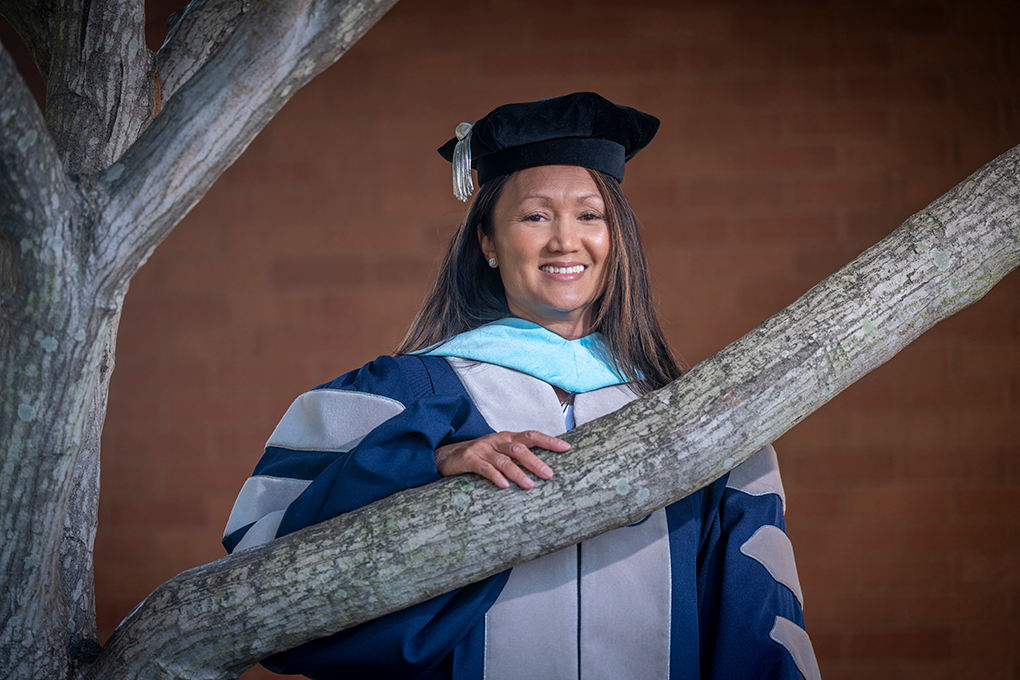
Having her cohort, lovingly nicknamed the C8 Family for cohort eight, in her corner throughout the tribulations that resulted in pushing back her graduation date, kept Denemark from getting burnt out.
“What really brought us together is our cohort. We had a very small cohort. We started with 22, and it went down to 12 or 13 over the three years,” she said. “We pushed each other and supported each other along the way. So, when they heard I was not going to walk with them, they were like, ‘Oh, no! Well, you can still do it!’”
Rhia Moreno, PhD, was also Denemark’s rock throughout the EdD process – serving as her chair, instructor and mentor, she anchored her to reality through many weekends filled with writing and a few tears shed while poring over her research paper.
“Joann was already doing amazing work in her director position at AU, and I knew she would bring that same energy to her dissertation. In my role as her mentor, we had frequent meetings and rounds of feedback and discussion through a growth mindset lens,” Moreno said. “After losing months of research and planning on her dissertation journey because of Hurricane Helene, Joann was determined to pivot and move forward even if it put her behind. She ended up producing a stellar dissertation that brought actionable change to her field.”
The inaugural cohort for the MHS-SLP program started this past fall with 23 students. It’s the only SLP program in the University System of Georgia affiliated with an academic health center, Wellstar MCG Health. Denemark noted the wonderful feedback she’s already received from students and how rewarding it has been to increase the output of qualified SLP graduates in hopes of helping alleviate the nationwide critical shortage.
As for what’s next, Denemark wants to continue conducting interprofessional education research to make her courses even more engaging for students and is looking forward to seeing where else this journey might take her.
“I never thought I would be working in higher ed, so you just never know what God has planned for the future,” she said.

 Delaney Freistuhler
 Valerie Emerick
 Felicia Baskett
 Stacey Eidson