Augusta University

 Valerie Emerick
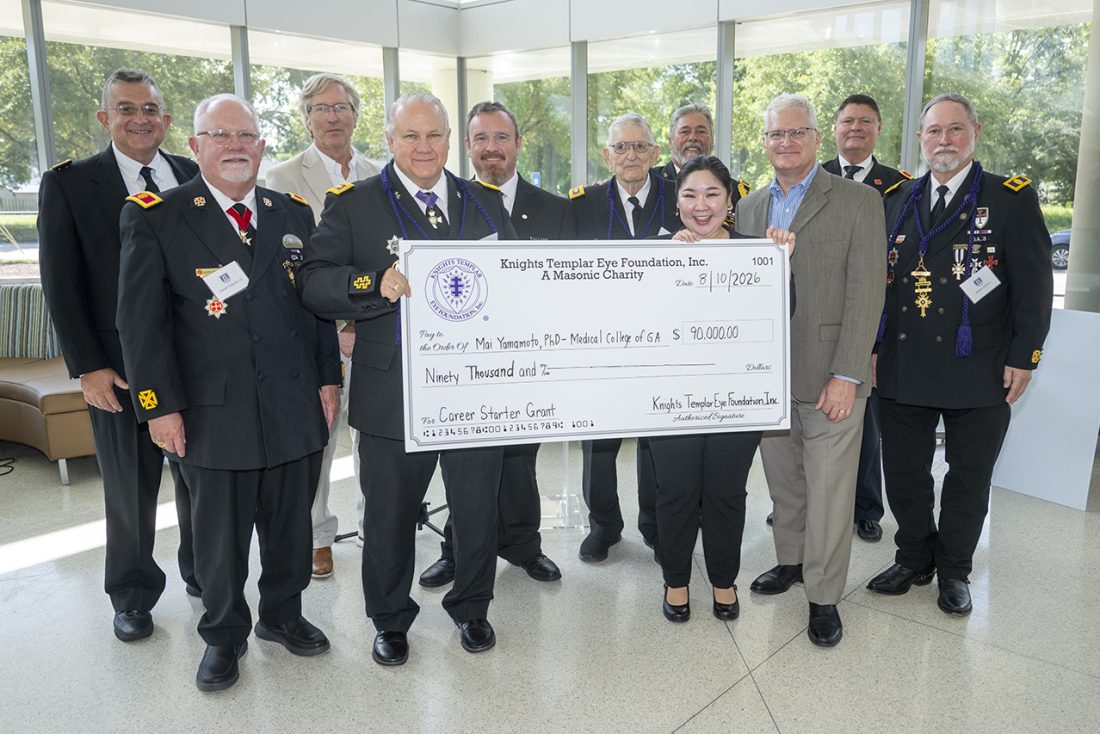
How can we protect the developing retina of babies born too early? That’s the question driving Mai Yamamoto, PhD, an assistant research scientist in the Vascular Biology Center at the Medical College of Georgia at Augusta University. Her search for answers received a boost Aug. 10 when members of the Knights Templar gathered at Augusta University’s J. Harold Harrison, M.D. Education Commons to present her with a $90,000 Career-Starter Research Grant from the Knights Templar Eye Foundation.
The disease at the center of her work, retinopathy of prematurity (ROP), is a leading cause of childhood blindness. It occurs when abnormal blood vessels grow in a premature baby’s still-developing retina and can cause serious, sometimes lifelong vision loss. Current treatments can control that blood vessel growth. But Yamamoto wants to know what else is happening in the retina itself and whether the body has protective tools scientists haven’t yet recognized. For her, the draw is the moment of discovery.

“What I love about science is the moment when something that was always there suddenly becomes visible,” she said. “Sometimes one new finding can change the way we understand what we have been seeing all along.”
Mai Yamamoto, PhD
Yamamoto is not a physician, but she sees research as her way of helping patients.
“If we can discover the mechanisms behind a disease and make findings that lead to better ways to prevent or treat it, I believe our work can ultimately help patients. That is what motivates me as a scientist.”
Her focus is interleukin-22 (IL-22), a protein the body makes naturally. In a mouse model of ROP, her team found that IL-22 reduced abnormal blood vessel growth and helped preserve retinal function. The team suspects the protein acts through Müller glial cells, which nourish and support the retina’s nerve cells and respond to retinal stress. The idea is that IL-22 signals these cells to switch on a protective response.
Yamamoto stresses that this is early, basic research. IL-22 is not a treatment for ROP, and the work so far has been done in mice. The protein can protect tissue in some settings and contribute to disease in others, so she said it is essential to understand exactly how it behaves in the developing retina.
Before the grant, her team had promising early evidence of that protection.
“The Career-Starter Grant gives me the resources to move beyond that initial observation and investigate how and why this protection occurs,” Yamamoto said. “Establishing that connection would take us from knowing that IL-22 has a protective effect to understanding how that protection works.”
She said the funding also helps her develop the project in her own research direction as she grows toward becoming an independent investigator.
Timing is part of the puzzle. An effective treatment must suppress harmful blood vessels while still allowing healthy ones to form, and because the retina changes so quickly in a premature infant, when a therapy is given may matter as much as what is given. Yamamoto hopes to pinpoint the stage at which IL-22 offers the greatest benefit and to learn whether this pathway could become a target for future treatments.
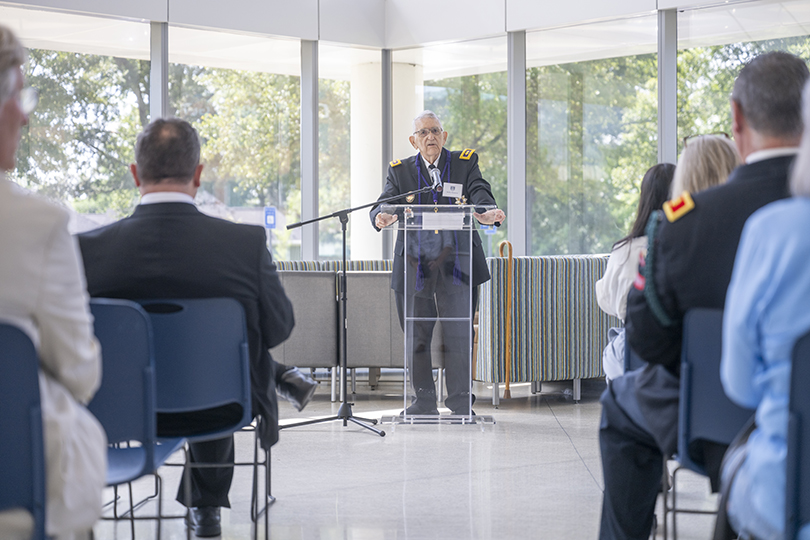
Her long-term goal, she told the audience at the presentation, is “to identify new therapeutic targets to prevent and to protect vision.”
Career-Starter Grants are awarded through a competitive process overseen by the Foundation’s National Scientific Advisory Committee. Steven Brooks, MD, professor and past chair of the Department of Ophthalmology and a member of the committee, said many in the room had launched their own careers this way.
“A bunch of us had our careers started with Knights Templar starter grants,” Brooks said. His came in the mid-1990s and was $20,000, “a world of money,” he recalled.
Advances in neonatal care mean babies are now surviving at earlier stages of pregnancy than when he began his career.
“The goalposts keep moving, and we have to move with them,” he said.
For the Knights Templar, the investment is as much about people as projects.
“When we invest in people, that’s what counts,” said Paul Friend, Southeast Department Commander of the Grand Encampment of Knights Templar, who recalled a longtime member, blind in his later years, urging him to do whatever he could to help others see.
Bobby Simmons, vice chair of the Foundation, said the work calls for both gratitude and faith in researchers.
“Being thankful for the past and trusting the future, there’s no way we can fail,” he said.
Yamamoto said she was “truly honored and grateful” for the award.
“Ultimately,” she said, “we want to promote healthy retinal development while protecting retinal function and vision.”

 Tyler Wooten
 Valerie Linares
 Aaron Smith