Augusta University

 Tim Rausch
A new research collaboration aims to transform the treatment of children with brain tumors by identifying hidden genetic drivers that current diagnostic technologies often miss.
The National Cancer Institute‘s Cancer Moonshot Scholars program has awarded a five-year, $3.7 million grant to develop clinical applications of optical genome mapping, or OGM, a cutting-edge technology that provides an unprecedented view of large-scale DNA changes.
The project, led by Miriam Bornhorst, MD, a pediatric neuro-oncologist at Ann & Robert H. Lurie Children’s Hospital of Chicago, will use the technology validated by the Georgia Esoteric & Molecular Library at the Medical College of Georgia at Augusta University, led by Ravindra Kolhe, MD, PhD.
“By using whole genome mapping, we will be able to make a better, more specific diagnosis, better classify the cancer, give a better prognosis based on that classification and enable better therapy choices,” said Kolhe, professor and chair of MCG’s Department of Pathology, who will serve as a key collaborator.
A closer look at cancer’s blueprint
The implications for pediatric cancer treatment could be substantial. Preliminary data suggests that approximately 30% of children whose tumors test negative on standard genetic tests might still harbor clinically significant structural variants that optical genome mapping can detect – variants that could inform prognosis, guide targeted therapy selection and determine clinical trial eligibility.
Under the grant’s framework, Kolhe’s laboratory will perform genome mapping on 400 pediatric brain tumor samples supplied by the bank of samples at Lurie Children’s Hospital.
Brain tumors represent one of the most challenging areas in pediatric oncology, with an estimated 350,000 cases occurring worldwide annually. Current diagnostic methods like karyotyping, a genetic test that examines an individual’s chromosomes to identify abnormalities in their number, size or structure often fail to provide comprehensive genetic information. In fact, published data suggests that approximately 30% of children whose tumors test negative on standard genetic tests might still harbor clinically significant large structural variants that might be equally important for understanding tumor behavior and treatment response.
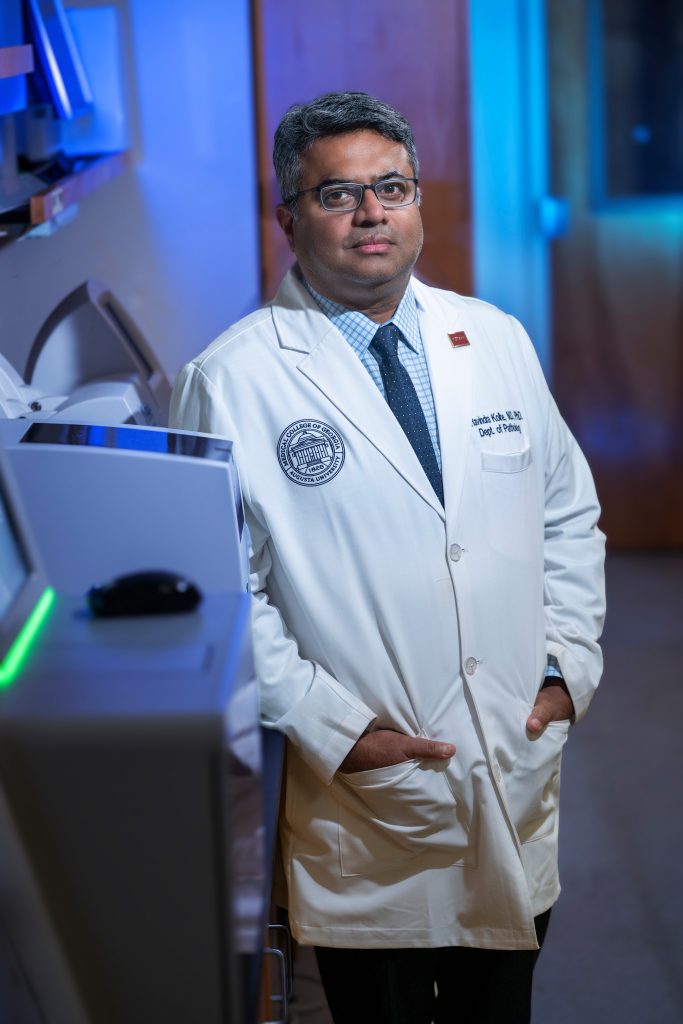
The inability to detect these larger changes could help explain why some brain tumors prove particularly difficult to treat or fail to respond to standard therapies, Kolhe explained. This is where this relatively new technology can open a new window – detecting novel variants that could inform prognosis, guide targeted therapy selection and determine clinical trial eligibility.
Under the grant’s framework, Kolhe’s laboratory will perform genome mapping on 100 pediatric brain tumor samples supplied by the bank of samples at Lurie Children’s Hospital.
Kolhe’s previous work with optical genome mapping in blood cancers demonstrated that the technology could reclassify approximately 20% of cases, changing them from low- to mild-risk categories – distinctions that directly influence treatment decisions and patient outcomes. Similar reclassifications in pediatric brain tumors could dramatically alter treatment approaches, potentially sparing some children from aggressive therapies while identifying others who need more intensive intervention.
How the technology works
The technology takes approximately 72 hours to map a genome, Kolhe said.
The optical genome mapping process begins with extracting approximately one gram of tumor tissue, from which researchers isolate high molecular weight DNA — extremely long, intact strands of genetic material. These DNA strands are then labeled with fluorescent dyes and threaded through narrow microfluidic channels no wider than the DNA molecules themselves.
“The DNA is tagged with colored dyes and guided through very tiny channels,” Kolhe explained. “As the DNA stretches out, we take extremely detailed pictures of it. Powerful computer programs then put those images together, letting us see the entire genome essentially every gene involved in the cancer.”
The resulting images allow researchers to visualize structural variations that would be invisible to other technologies. These include complex rearrangements where multiple genes swap positions, large deletions that remove tumor suppressor genes, and duplications that amplify cancer-promoting genes – all potential drivers of tumor growth and treatment resistance.
Building a collaborative framework
The collaboration between MCG and Lurie Children’s Hospital emerged from complementary strengths. Lurie Children’s maintains one of the nation’s largest repositories of well-characterized pediatric brain tumor samples, while MCG brings expertise in OGM technology and analysis.
“They have a huge amount of these brain tumor samples, well categorized and stored, but they don’t have expertise in terms of running these samples, looking at it and analyzing that,” Kolhe said. “So that’s how the collaboration started.”
The partnership began when Bornhorst, recognizing the potential of optical genome mapping for pediatric brain tumors, reached out to Kolhe’s team.
The first phase, running from January through June, will focus on analyzing 50 brain tumor samples to validate and optimize the testing process, Kolhe said.
“We will be validating it and then publish it so that other labs can jump on it and use this technology with a certain level of effort in a clinical diagnosis of pediatric brain tumors,” Kolhe added.
The grant represents one component of the NCI’s Cancer Moonshot initiative, originally launched in 2016 and reestablished in 2022, with the goal of accelerating progress in cancer prevention, diagnosis and treatment. The program already has supported more than 250 research projects.


 Miguelangelo Hernandez
 Nina Siso
 Chris Curry