Augusta University

Trent M. Kays, PhD
Assistant Professor and Director of Professional Writing and Rhetoric and faculty affiliate in Women's and Gender Studies
- Augusta GA UNITED STATES
Spotlight
August 17, 2026
2 min
Multimedia


Biography
Trent Kays, PhD, is an assistant professor and Director of Professional Writing and Rhetoric in the
Department of English & World Languages at Augusta University's Pamplin College of Arts, Humanities, and
Social Sciences, where he is also affiliated faculty in Women's and Gender Studies.
His research centers on digital rhetoric and online culture, exploring how communities build credibility and
authority outside formal institutions, and how digital platforms shape rhetorical practice more broadly. His
scholarship also examines queer rhetoric within digital spaces, arguing that queer identity and community
formation are foundational to how the internet functions as a rhetorical space.
More recently, Kays has focused on artificial intelligence and its effects on writing and composition instruction.
He was named a 2025 Georgia Governor's Teaching Fellow, one of sixteen faculty selected statewide, for his
work developing AI literacy curricula that teach students to use generative AI tools critically rather than as a
substitute for their own thinking.
Kays holds a PhD in Rhetoric and Composition/Writing Studies from the University of Minnesota and an M.A.
and B.A. in Professional, Technical, Business, and Scientific Writing from the University of Arkansas at Little
Rock. He serves as an officer of the Conference on College Composition and Communication's Queer Caucus and is
a member of its Committee for Change and Nominating Committee.
Areas of Expertise
Accomplishments
Governor's Teaching Fellow
2025-05-27
Selected as one of 16 faculty statewide for Georgia's Governor's Teaching Fellows Program, run by the Institute of Higher Education at the University of Georgia, recognizing his work integrating AI literacy into writing instruction.
Education
University of Minnesota
PhD
Rhetoric and Composition/Writing Studies
2020University of Arkansas at Little Rock
M.A.
Professional, Technical, Business, and Scientific Writing
2010University of Arkansas at Little Rock
B.A.
Professional, Technical, Business, and Scientific Writing
2008Affiliations
- Conference on College Composition and Communication (CCCC), Nominating Committee — Member
Links
Media Appearances
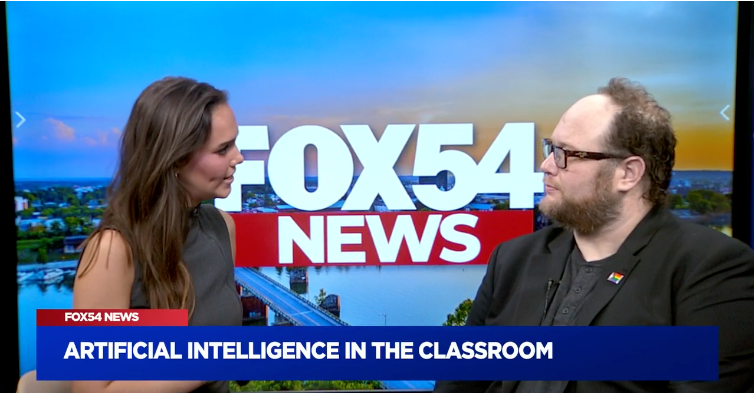
AI in the Classroom: Augusta University Professor Explains the Benefits and Risks
FOX54 News (WFXG) tv
2026-08-17
Discussed how students are using AI for brainstorming, studying and writing; the risk of AI generating inaccurate or fabricated sources; cognitive offloading and its effect on critical thinking; and the need for clear classroom guidelines around AI use.
Articles
Technical Communication Education in a Digital, Visual World
2012 IEEE International Professional Communication Conference (IPCC)Co-authored conference paper arguing that technical and professional communication education must integrate digital and visual media into classroom practice.
Blog and Wiki Discourse
The International Encyclopedia of Language and Social Interaction (Wiley)2015-04-07
Co-authored reference-work entry on the discourse patterns of blogs and wikis as genres of online communication.
Digital Education and Oppression: Rethinking the Ethical Paradigm of the Digital Future
International Review of Information Ethics2014-07-01
Examines how digital educational systems can reinforce existing inequities and argues for reconsidering the ethical foundations of technology adoption in education.
Between Queer and Digital: Toward an Understanding of the Rhetoric of Digital Queerdom
The Routledge Handbook of Queer Rhetoric (Routledge)2022-04-25
Book chapter arguing that queer rhetoric should be understood as foundational to digital rhetoric and the broader internet, examining how digital platforms shape queer identity and rhetorical practice.